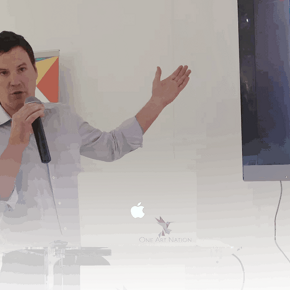
Nelson Saiers is a New York-based artist who uses abstract mathematics as a compositional framework to create paradoxically “realist” artwork about history, representation, social justice, and great artists of the past. His work uses sophisticated mathematical concepts, metaphor, and wordplay to connect seemingly disparate subjects.
In a 2019 work about Napoleon, for example, the gluing property of mathematical sheaves models how Napoleon's empire formed from individual territories. The multiple meanings of sheaf also matter, as sheaves of grain would have been invaluable to Napoleon's starving army during its failed invasion of Russia. The work is typical of Saiers's approach to representation, in which abstract mathematical concepts help tell a story rather than simply illustrate or decorate.
Saiers's exhibitions include a six-month solo installation at Alcatraz addressing mass incarceration using properties of PI. A year-long solo exhibition at Harvard University's Leverett House used gravitational physics to wrestle with giants of art history. His artwork has also appeared at the Lincoln Memorial and galleries throughout New York City. Saiers has staged provocative guerrilla interventions at the Federal Reserve Bank, the Museum of Modern Art, the Metropolitan Museum of Art, and other important locations.
Saiers earned his Ph.D. in mathematics in just one year at the age of 23. Before becoming an artist, he worked in finance as a Managing Director at Deutsche Bank, where he ran a proprietary trading group, and later as CIO of Saiers Capital (formerly Alphabet), a hedge fund recognized with HFM's 2011 award for top relative value hedge fund. He was dubbed “the Warhol of Wall Street.”
Get to Know Me
What are the most challenging aspects of your work?
Abstract mathematics. For me, math isn’t merely another type of “ready-made,” a found object that can be called art. It is load-bearing. It becomes the framework for constructing the artwork’s meaning and telling its story, so the symbols aren’t arbitrary. For example, in What Is Left (2022), the brilliant use of arrows instead of subsets to define “open sets” when studying polynomial equations over finite fields mirrors Henry V’s ingenious use of arrows to defeat the French on the rain-soaked fields of Agincourt. In Stack (2022), by filling Judd-style boxes with hay, I punningly produce a “haystack,” turning Judd’s non-representational stack into a reference to Monet, while the mathematical “stack” on the wall returns it to abstraction. And in Pollock Stymied No. 5 (2015), Pollock’s drip process becomes impossible in a studio in free fall: the paint and canvas fall at the same rate, so the paint never lands, leaving drips on the outside of the falling room but not the inside.
How did you begin your career in the art world?
I had my first show at Studio Vendome gallery in New York City.
If you could have dinner with 3 artists from the past- who would they be?
I would love to sit down with Michelangelo, Cezanne, and Kandinsky. This is why... Few reach the heights of Michelangelo. Cezanne attempts to answer interesting questions, and I think Kandinsky used music as a basis for art. I'm attempting to use mathematics. The approach I'm taking is different, but I think there is a bit of an analogue.