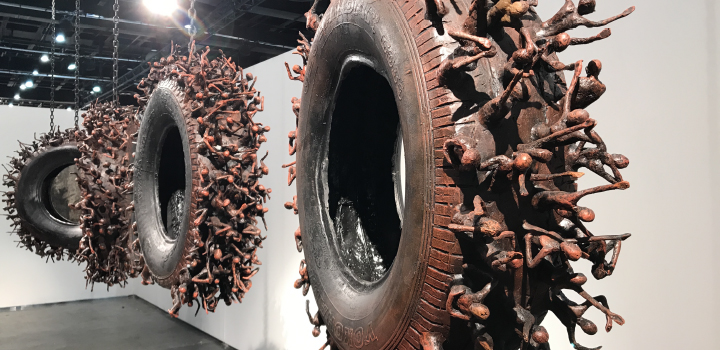
Since the early 2000’s our perception of street art has evolved from the discussion of whether it’s vandalism or not to the question of how much a Banksy will bring at auction. Since entering the mainstream contemporary art market as a category to be taken seriously in its own right, millions of dollars of urban art has sold every year at the big auction houses and top galleries. Buyers range from art lovers interested in purchasing their first piece to seasoned art collectors who are looking at urban art as worthwhile investment. Corporate and consumer brands spend big bucks to incorporate street art into their branding.
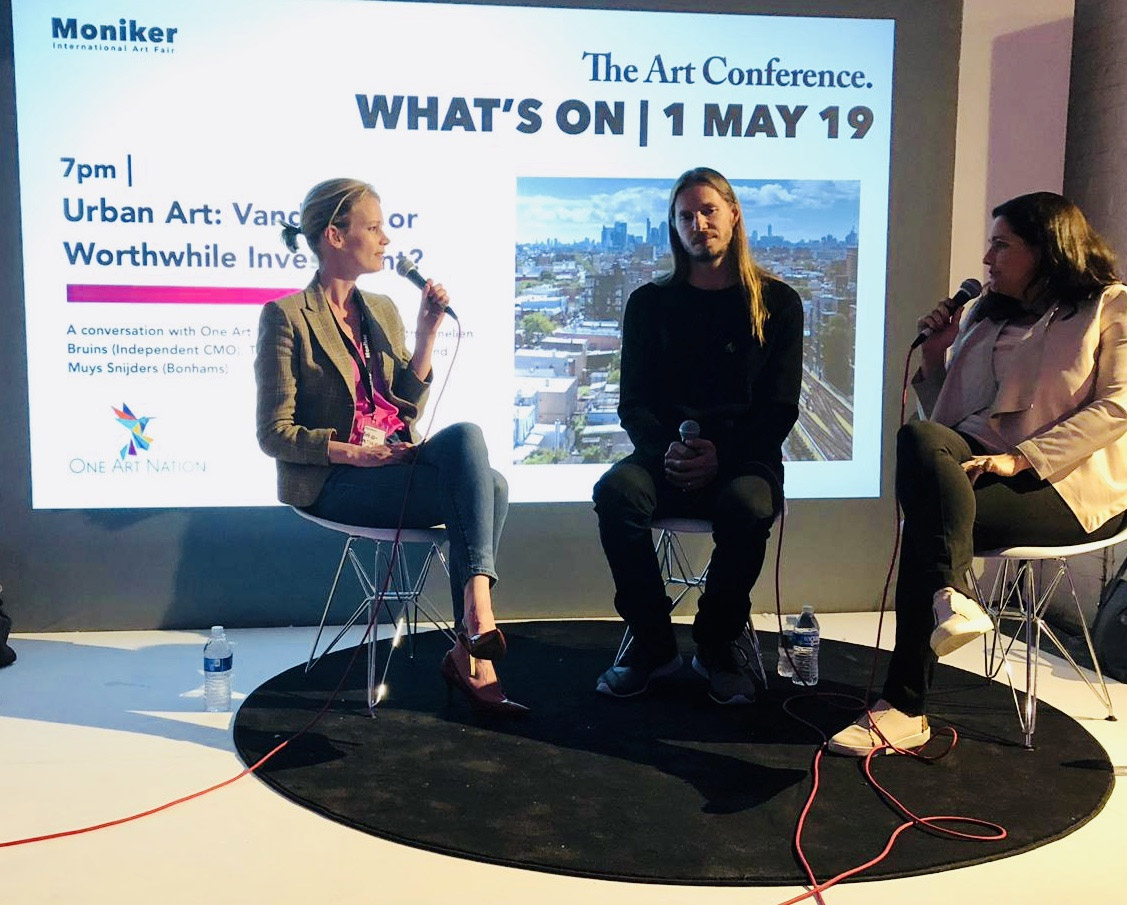
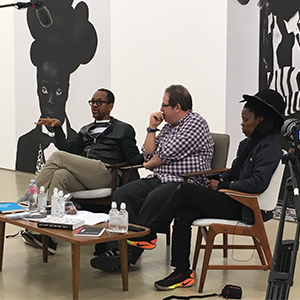
Annelien Bruins sits down with Muys Snijders, Head of the America’s Post-War & Contemporary Art Department at Bonhams, and Tony “Rubin” Sjöman, Manhattan based mural and studio artist to interview them on how street artists increasingly dominate the contemporary art market and how they have managed to turn graffiti into a sought-after investment.
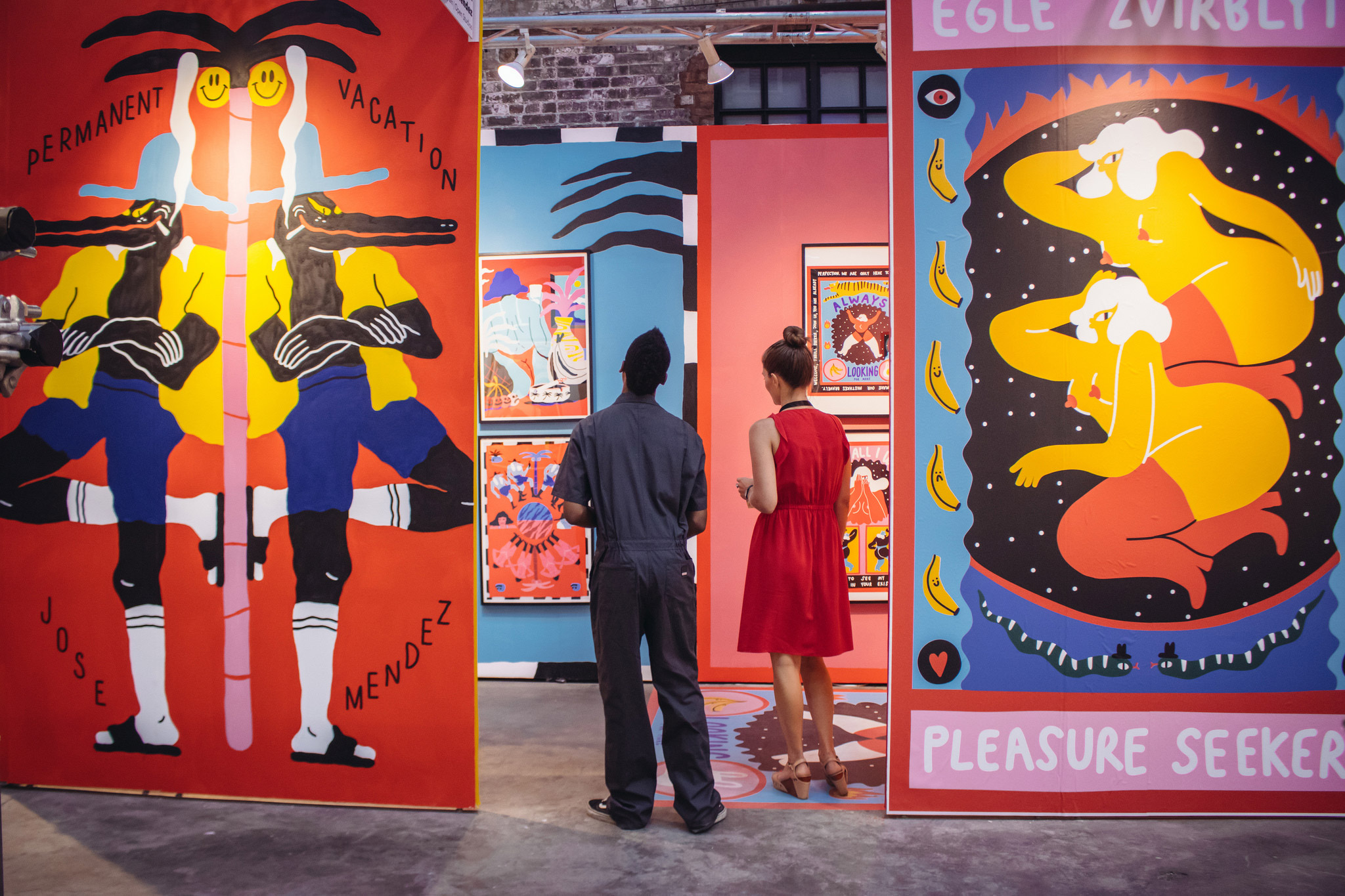
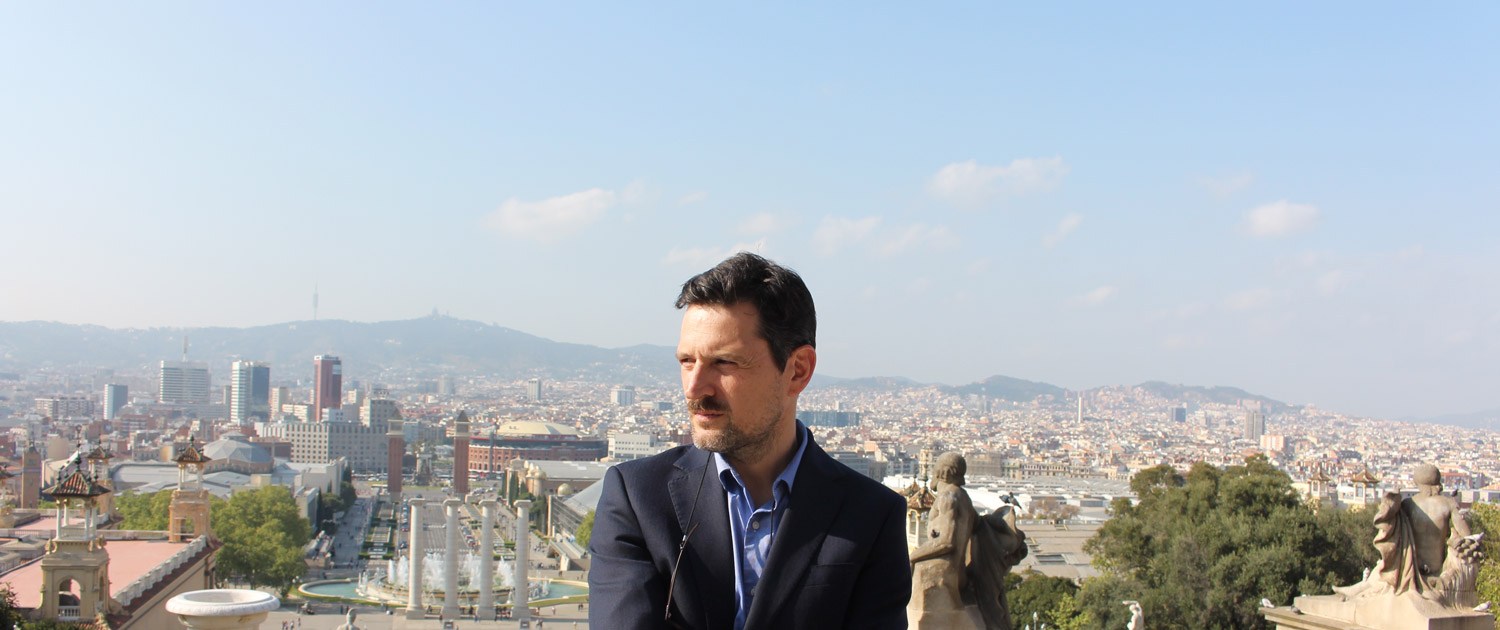
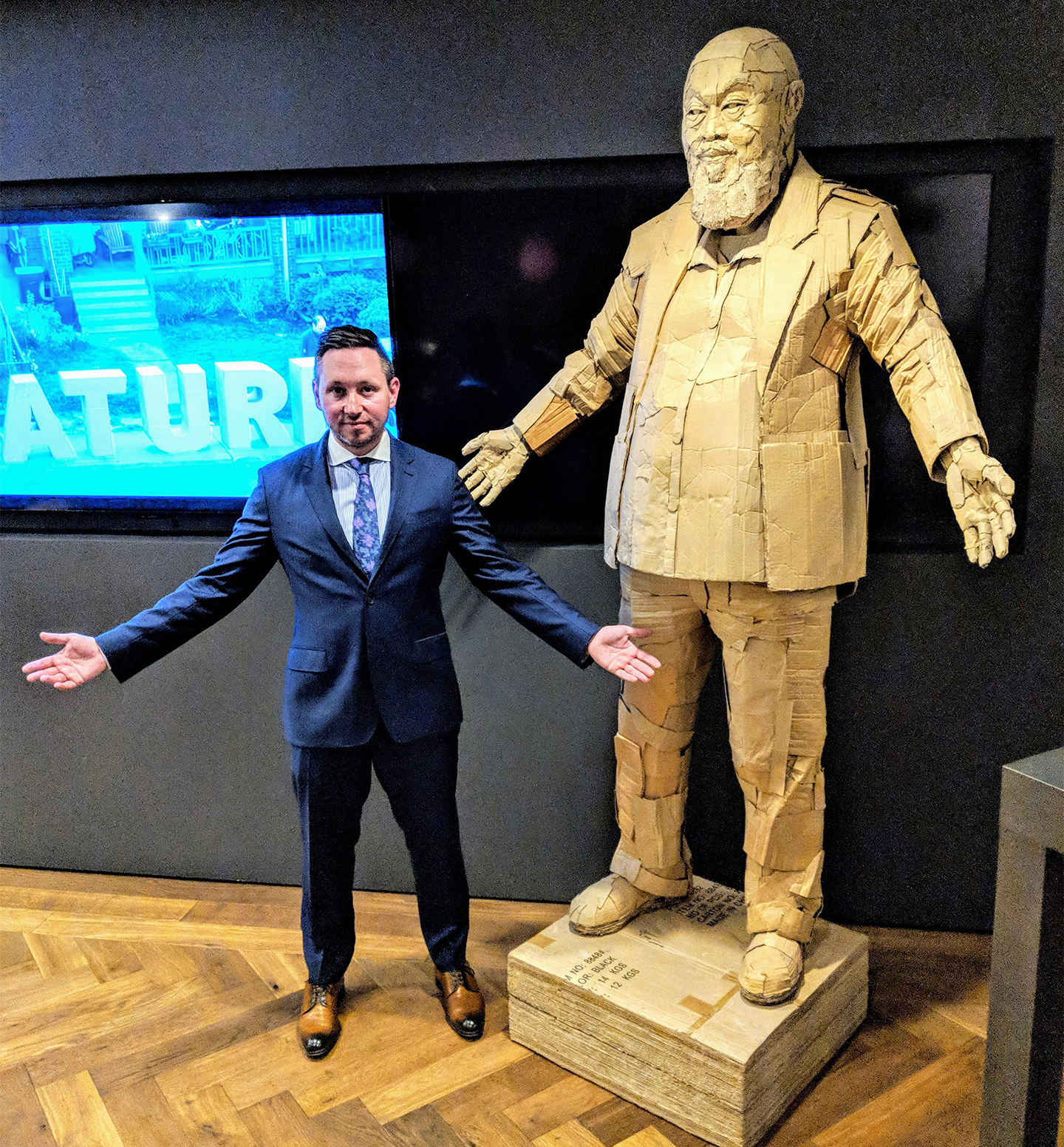
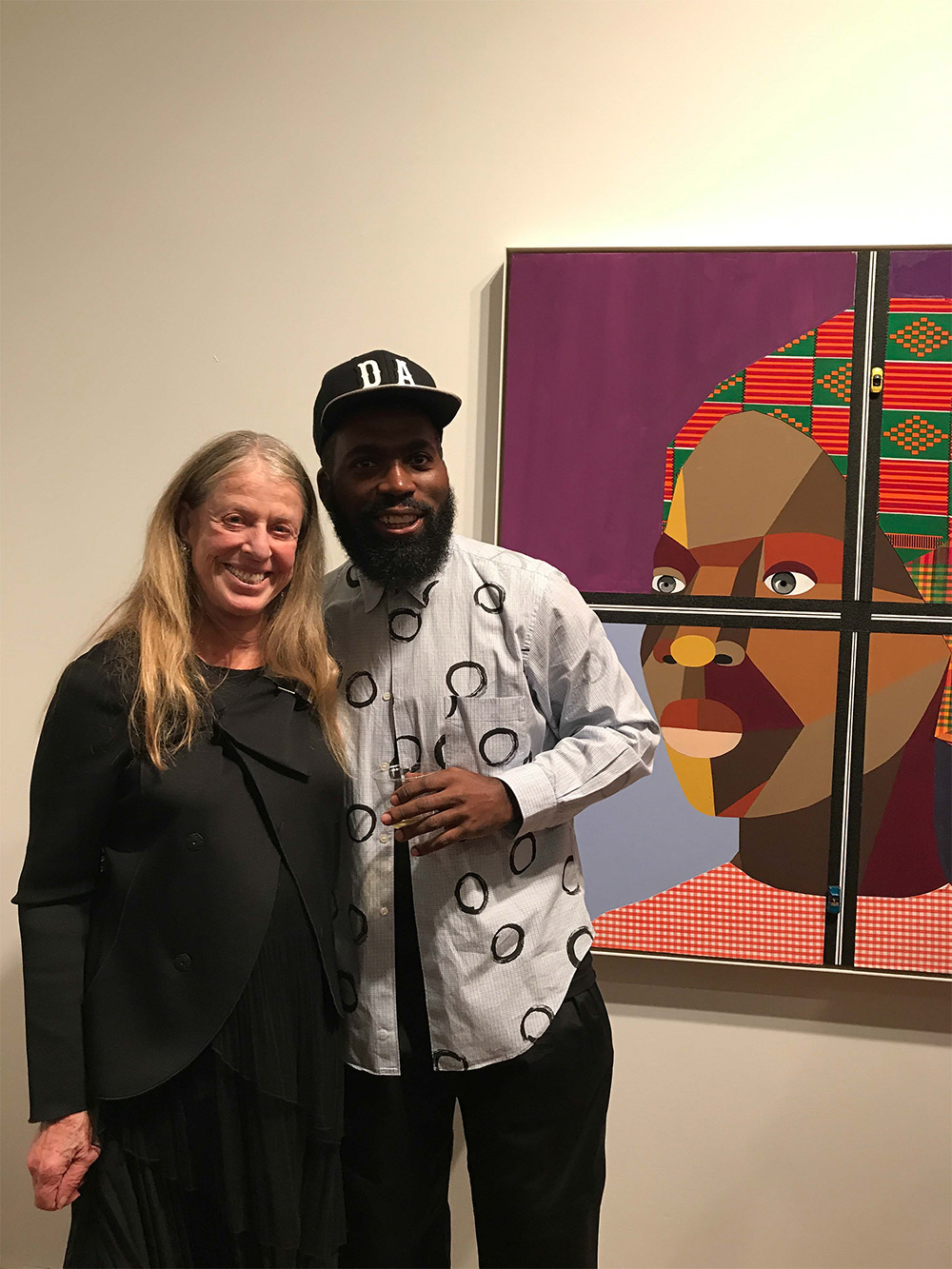
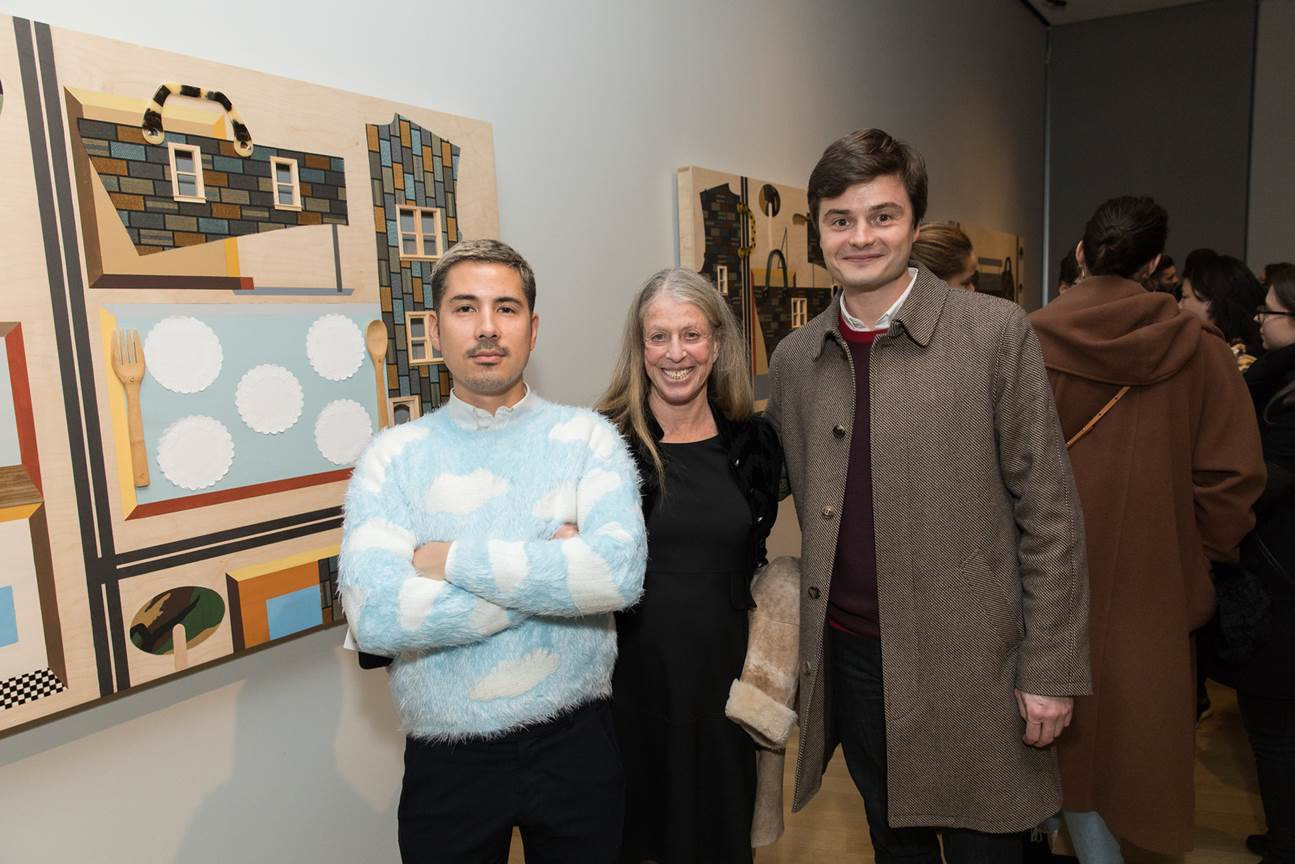
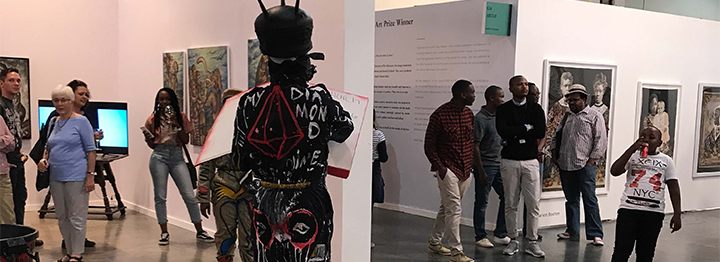
Annelien Bruins, Tony Rubin-Sjoman and Muys Snijders at Moniker Art Fair
What is the difference between Graffiti Art and Street Art?
Some say there is no difference and that they are all one in the same. But generally, Urban Art is overarching. Graffiti Art is more word-based social commentary and Street Art is more visual and image-based and grew from Graffiti Art. Keith Haring and Jean Michael Basquiat were not what you’d consider “traditional” Graffiti artists.
How do you go from creating art on walls to selling it in galleries?
There’s no simple answer. It’s a gradual process where one thing leads to another. When you start creating work in a studio, it can lead to exhibition spaces and galleries.
Has Street Art attained a position in the contemporary market?
Absolutely. Artists that started on the street are coming in and out of the market through the gallery world and secondary market. Bonhams has been offering sales of Street Art since 2008. Artists are going main stream and are ending up in the top evening sales.
Street Art in general is more accessible across different mediums from skateboards and billboards. And, unlike other art categories, it’s very international. The market will continue to grow as more attention is given to these artists. The works also speak to a younger generation of art collectors that easily identify with and understand the works.
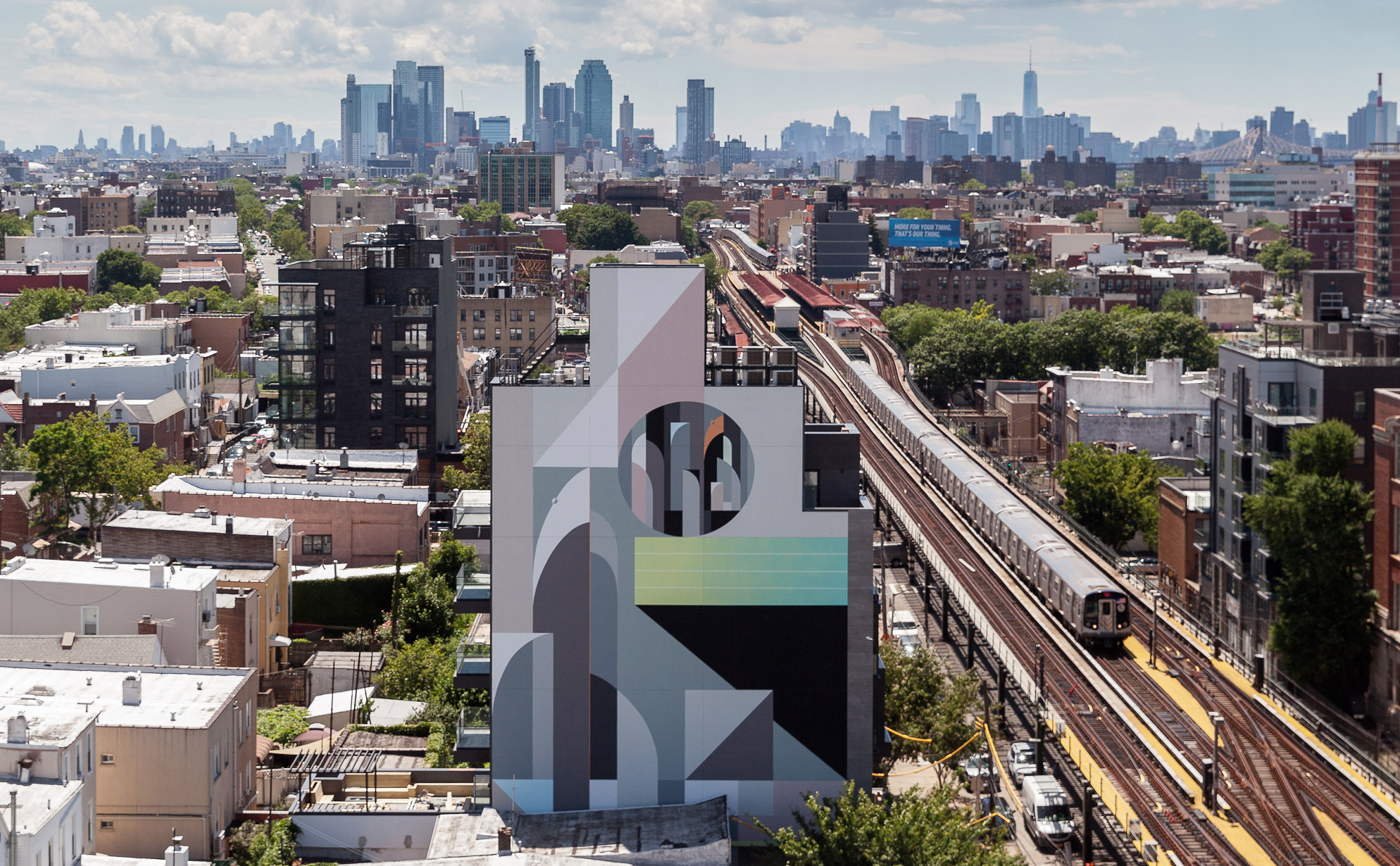
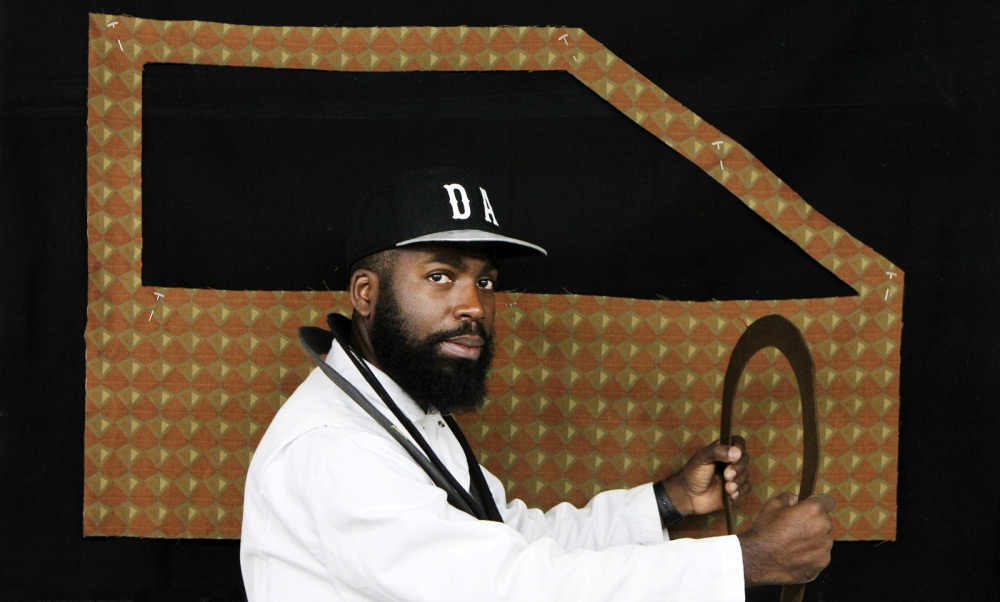
Tony Rubin-Sjoman: NYC – 2017
Is there a big international client base?
It’s amazing what Instagram has done to the growth of the international Street Art market. It has propelled Street artists to the international forefront. It’s also a great tool to use when identifying which artists have come to market. Artists can show their work and the process behind it as opposed to just selling work on the platform.
What makes a good Street artist and does the same criteria apply as it does in the contemporary art market?
One of the ideas behind Graffiti Art is to not follow any rules. But nowadays, there are just so many rules. If the work is honest and authentic, that’s all that matters.
Sadly, there are a lot of fakes across all categories including Street Art. When making any significant investment, do your research and homework. If it’s too good to be true, it probably is.
Where do you buy Street Art?
Visit artist’s studio to get to know the artist and actually see the process. The process can be more important than the actual work. Other viable options are a gallery show or contemporary art fair such as Moniker Urban Contemporary Art Fair.
How do you feel about art being removed and sold from walls?
If you do something illegal on the streets, unfortunately you don’t have much claim to it. But when it comes to ethics, of course it’s not correct. So where do you draw the line?
You can listen to the audio recording of the discussion here.
Prologue
As an art lawyer, I am interested in the intersection between art, law and politics — particularly in reference to the body politic. As a founding board member of Performa, Roselee Goldberg’s New York-based visual performance art biennale and for years involved in representing artists who work in the public sphere on percent or corporate commissions, my interests are particularly in art which challenges and interacts with existing hegemonic political structures and efforts by artists to cut through existing stereotypes and biases, to assert cultural and personal identities often marginalized or invisible. Such art often brings engagement in critical, sometime humorous dialogue with an audience to the forefront. Thus, in planning my agenda to review the 58th Biennale, I was particularly interested in visiting National Pavilions appearing at the Biennale either for the first time, such as Ghana and India, or National Pavilions with an emerging contemporary art scene not known globally, such as Mongolia. Having been inspired by the second edition of the Mongolia Pavilion Venice 2017, I visited Mongolia in October 2018 to experience the nomadic lifestyle and culture by a visit to the Golden Eagle Festival in the Altai mountains of western Mongolia, October 2018 and the art scene in the capital, Ulaan Batuur. I was also interested in the Pavilion of the Islamic Republic of Iran. I have been following Iran and its art scene since I had the privilege of visiting and learning about its ancient and rich cultural heritage during a visit in 2017. And in the interest of transparency, I was thrilled to see Martin Puryear represent the United States. Many New Yorkers and visitors to Madison Square Park are aware of his magnificent sculpture installation entitled Big Bling (c) (2016) , commissioned by Madison Square Conservancy. That commission inspired the Conservancy to apply to sponsor Martin and the Pavilion to the Department of State that selects the curator and artist for the US Pavilion, which is owned by the Peggy Guggenheim Museum in Venice. Madison Square Park Conservancy is the first public park organization to have been selected for this role. I have followed Martin’s career and amazing work for years, as well as representing him on a number of public art projects, including for the Getty Museum and the US Embassy in Beijing.
This year there were 90 National Participants or Pavilions located principally in the Arsenale, the Giardini and with about thirty throughout Venice . The curated International Exhibition is different from the official National Pavilions and is displayed in the Central Pavilion of the Giardini, as well as the Corderie of the Arsenale. The artistic director is selected by the Bienale foundation and sets the agenda for the Bienale and the International Exhibition.
Rugoff’s Curated International Exhibition
The ostensible non-theme for this year’s Biennale, selected by the artistic director Ralph Rugoff, was based on a fictitious Chinese proverb “may you live in interesting times.” Notwithstanding that the Venice Biennale started having themes in 1972, Rugoff stated that the 58th International Art Exhibition will highlight a general approach to making art and a view of art’s social function as embracing both pleasure and critical thinking. The title was meant to suggest and represent false news. Rugoff selected 84 contemporary living artists to participate. He explains his choices as follows: “all of the artists in this exhibition were selected because in some way their work acknowledges the open ended character of this exchange with the viewers own associative responses and interpretations to give meaning to their works of art. May You Live In Interesting Times has been formulated in the belief that an exhibition, like a work of art, is most deeply engaging when it provokes a vivacious inquisitiveness and encourages us to wonder and to question, and to try to better understand how different pieces of the world fit together.”
In a departure from Biennale practice, Rugoff gave each selected artist space in the Arsenale (Proposition A) or in the Giardini Central Pavilion (Proposition B). This was not a particularly successful endeavor for all artists, nor was the entire curated installation. While there were many successful installations and important works by artists both established and emerging, the International Exhibition as a whole in my opinion did not work as a curated exhibition: the artistic director’s description of the curated exhibition was too general to present any real order or direction to the the installations which ranged from mini gallery exhibitions to large scale installations. Far from highlighting “artworks that explore the interconnections of everything,” I found it difficult to experience how the artists spoke to each other.
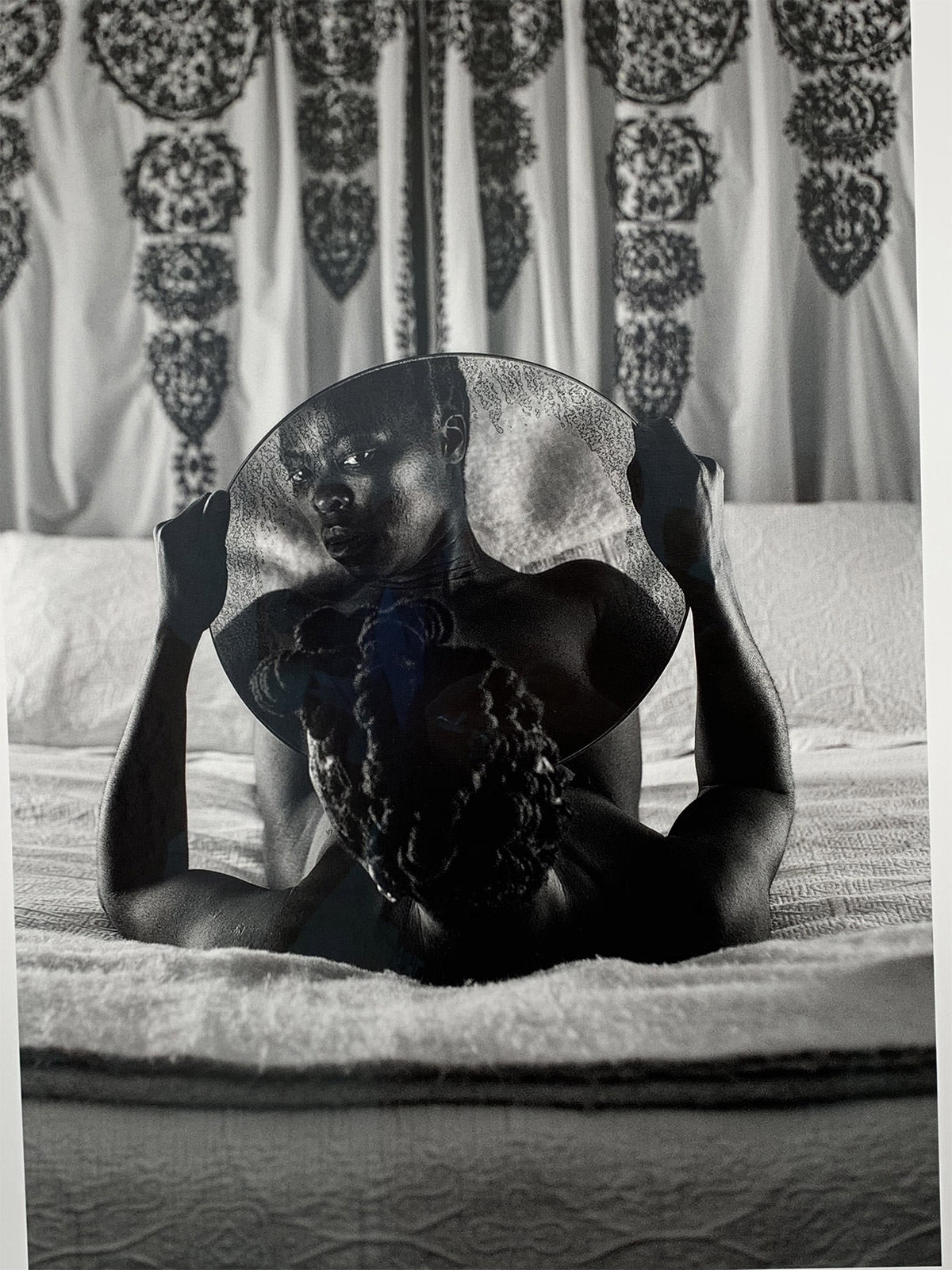
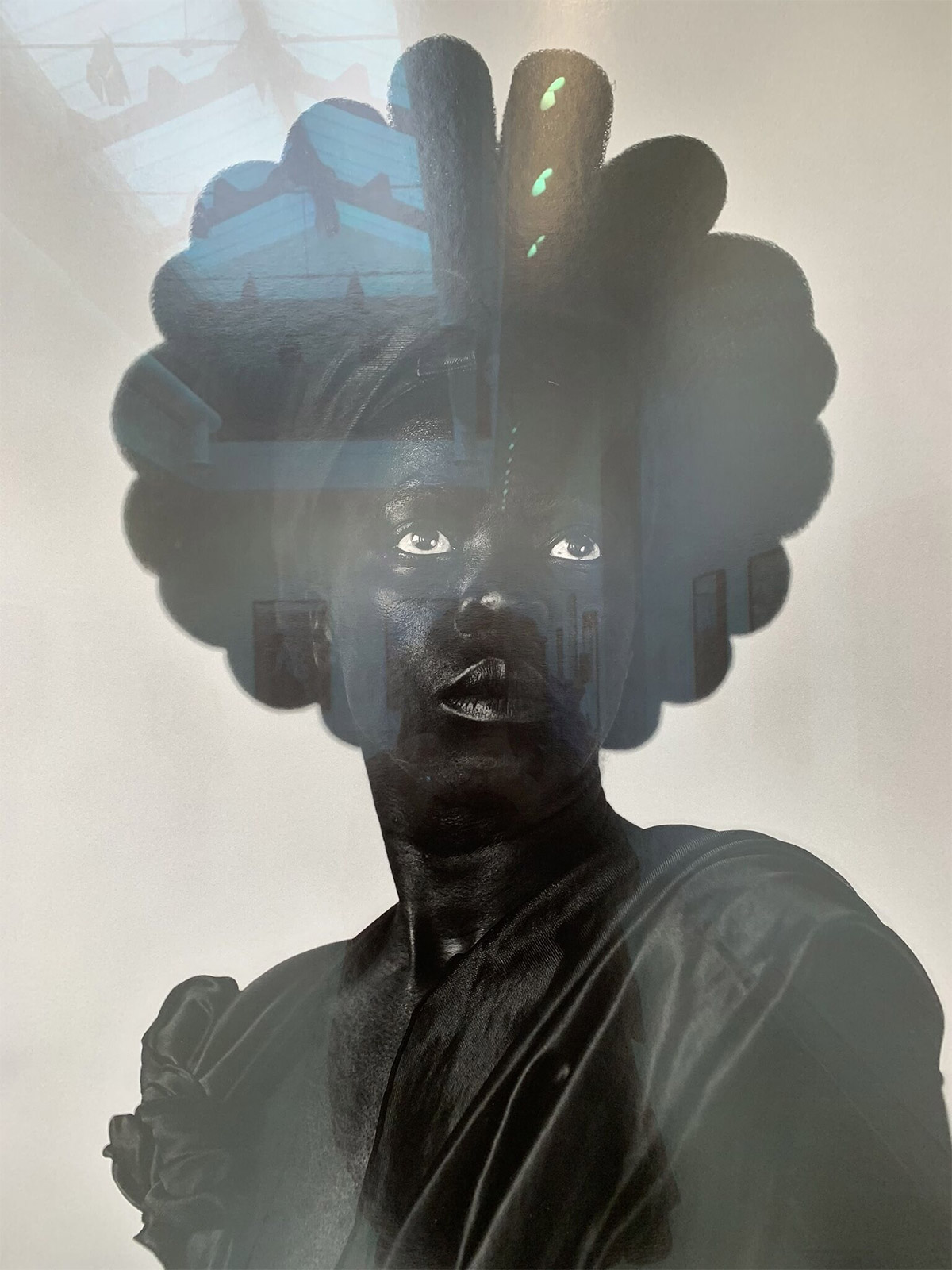
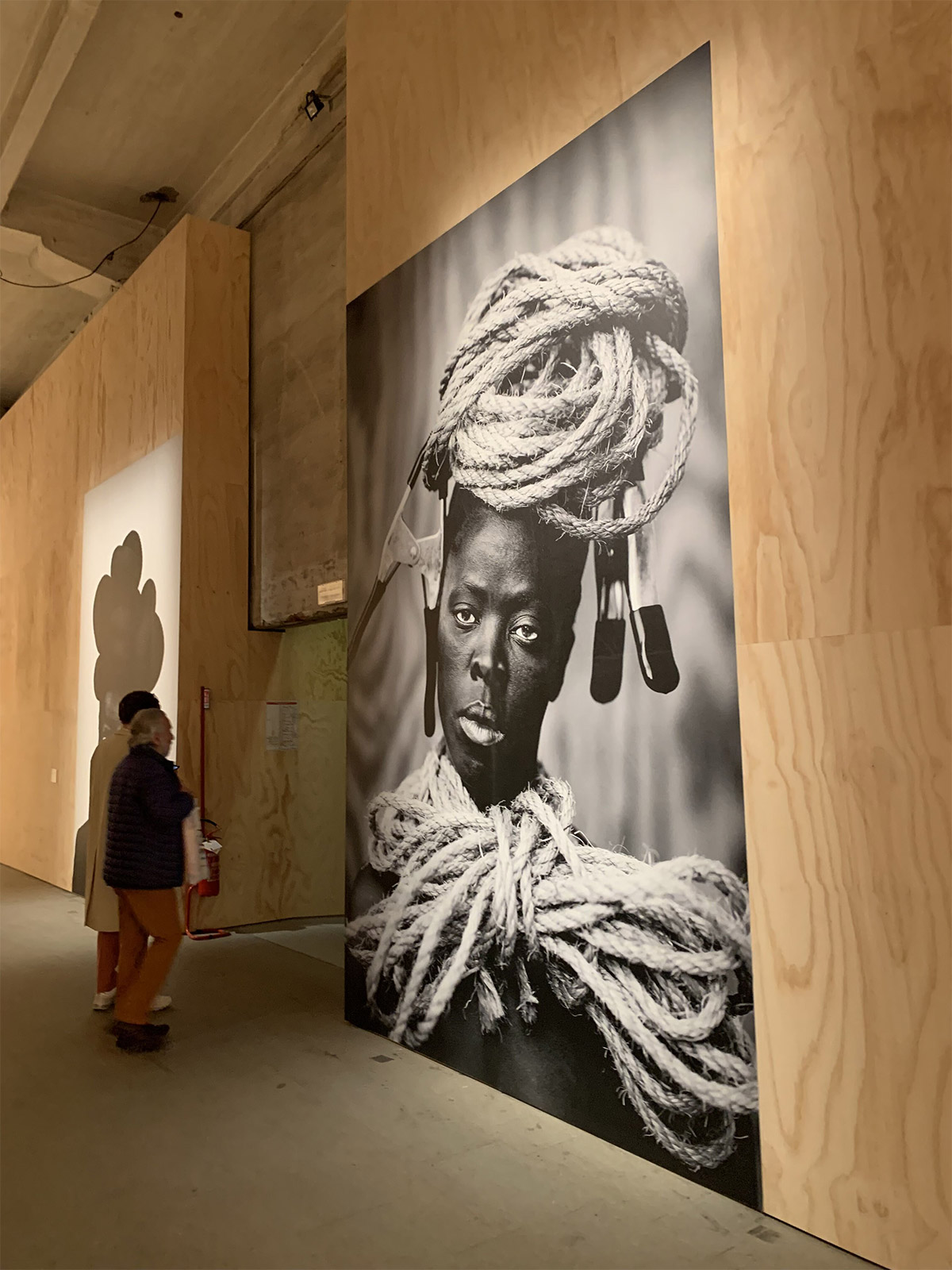
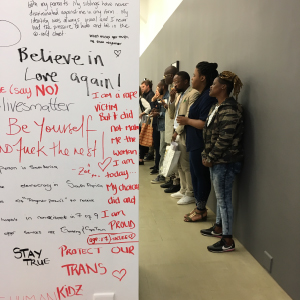
Photographs by Zanele Muholi in the Giardini
Photographs by Zanele Muholi in the Giardini
Photograph by Zanele Muholi in the Arsenale
The lack of curatorial vision or agenda made me recall with nostalgia some of the brilliantly curated themed exhibitions by other artistic directors over the years.
For example, the 52nd International Art Exhibition, directed by Robert Storr, Think with the Senses – Feel with the mind: Art in the present tense; the 54th International Art Exhibition, curated by art historian and critic Bice Curiger, ILLUMInations; the 55th International Art Exhibition, curated by Massimiliano Gioni, curator at the New Museum, The Encylopedic Palace. In that exhibition, performance artist Tino Sehgal was awarded the Golden Lion for Best Artist, the first time a performance artist was a recipient of this award. Angola, a first time Pavilion, deservedly won the Golden Lion for Best National Participation with an extraordinary site-specific installation by photographer Edsen Chagas, “Luanda Encyclopedic City”, in the rented Palazzo Cini, a museum of Renaissance art, with wonderful paintings by Pontormo, Giotto, Botticelli and Piero della Francesca. There is a significant overlap in artists selected in this International Exhibition and that of The Encyclopedic Palace.
After two walkthroughs, I still really longed for the clarity and the vision of the recently deceased Okwui Enwezor, artistic director for the 56th International Art Exhibition titled All The World’s Futures, and Okwui’s even more brilliant artistic curatorship of Documenta11 (2012). There are definitely others who prefer the more flexible curatorial approach of Rugoff, which can include any artist he likes.
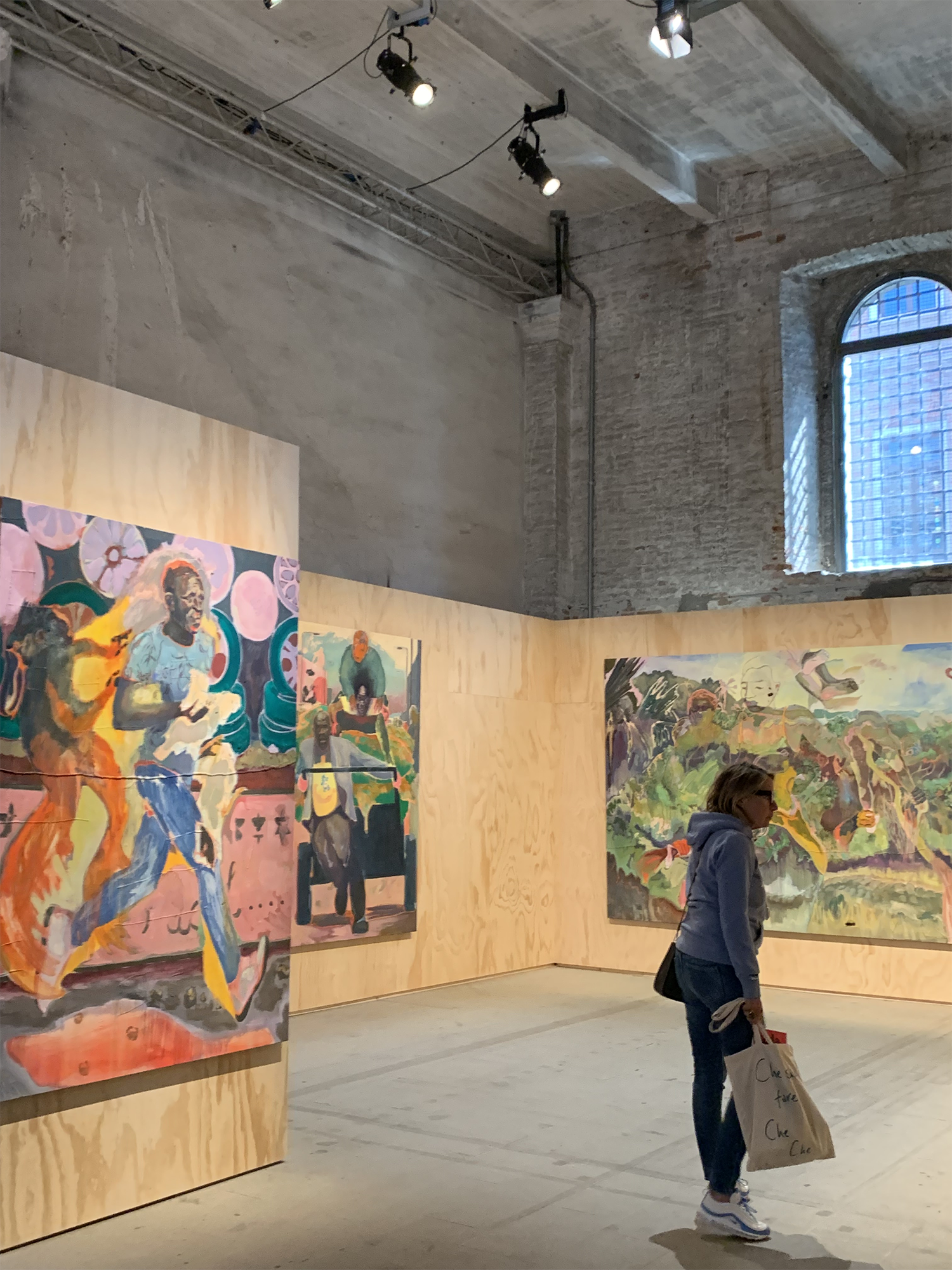
The International Exhibit is always been a place of discovery: Pipoletti Rist, Ever is Overall (1997), El Anatsui, DUSASA II (2007), Tabimo (2007), and Lynette Yiadom-Boakye (2013). These artists have gone on to well-deserved art world success. Anatsui and Yiadom-Boakye are in the Ghana Pavilion. This year, I also made new discoveries. For example, Michael Armitage: his work was installed in the Arsenale as almost a mini-gallery exhibition. He also has some beautiful pen and ink drawings in the Giardini. Armitage hails from Kenya and works in Nairobi and London, represented by White Cube. In October, he will have a solo exhibition curated by Thelma Golden, at MOMA. He is definitely an artist to watch.
Michael Armitage, Pathos and the twilight of the idle, (c) 2019
For those with extremely limited time who nevertheless want to see the International Exhibition, my suggestion is to get a detailed map from the Biennale website or the Exhibition catalogue, which indicates where particular artists are located in both the Arsenale and the Giardini and seek out only those artists.
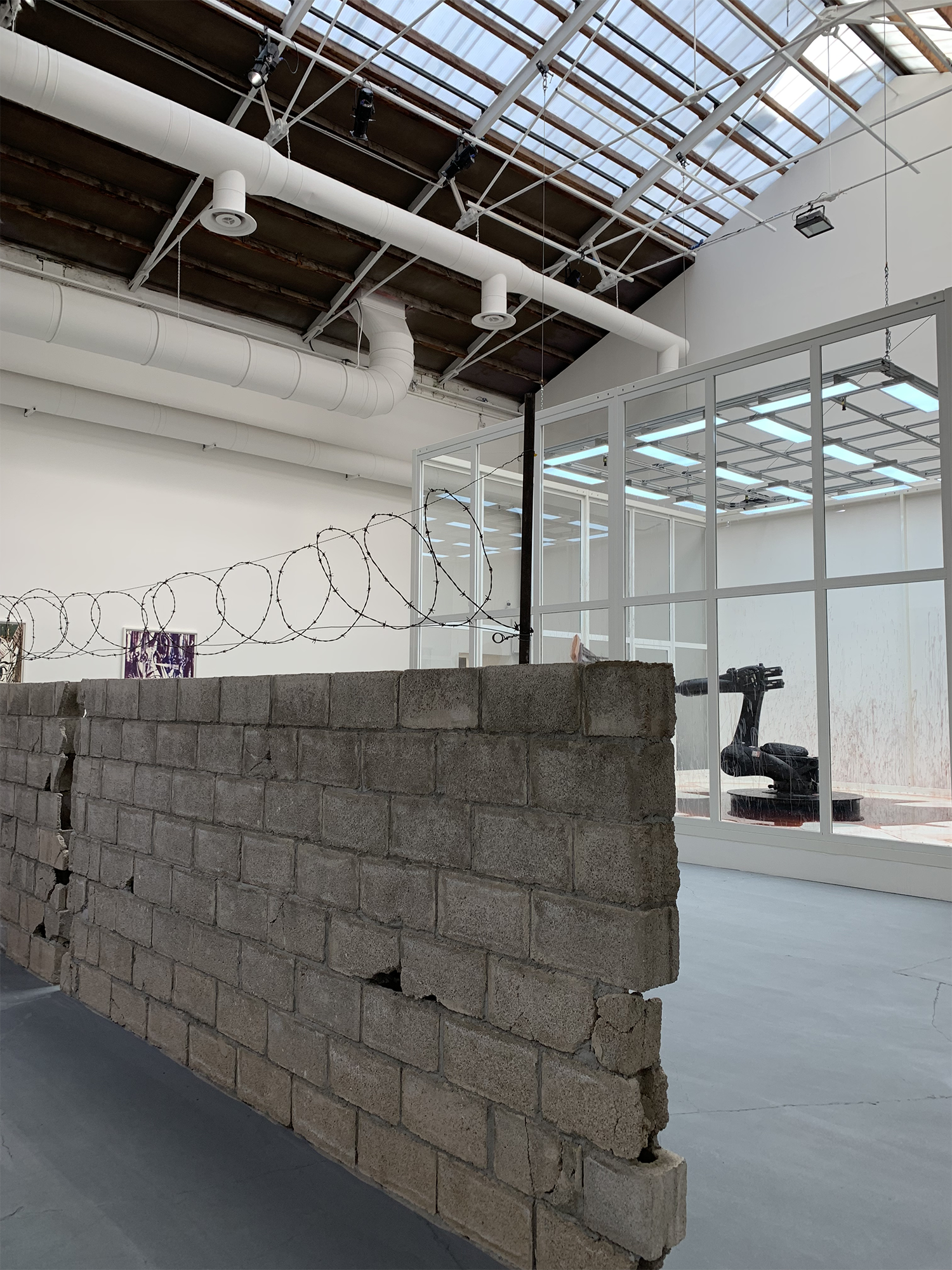
Lawrence Abu Hamdan and Teresa Margolles are artists who I have followed and put in my own “curated” exhibition, When the Body Becomes Art (c) (2015). Hamdan focuses on the politics of listening, whilst Margolles trains a feminist lens onto the brutalities of narcoviolence that pervade her home country of Mexico. Having throughout her practice thematised governmental negligence, the social and economic cost of the criminalisation of drugs, and the specific textures, smells and physical remains – that is to say, the materiality – of death. For Mura Ciudad Juarez in the Central Pavilion, she installs sections of a concrete wall with barbed wire riddled with bullet holes to depict violence. She was awarded special mention by the jury. I found perhaps this section of the International Exhibition, including also the works of Shilpul Gupta, Untitled (c) 2009 (mobile gate) and Sun Yuan (1972) and Peng Yu (1974) China, Can’t Help Myself (c) (2016) and Christian Marclay, The Scream (c) (2018) the most successful curated part of the International Exhibition. I experience a sense of emotional fear and uncertainty collectively expressed by these artists for the times in which we live. Particularly Can’t Help Myself, with the constant interplay between the fluid and the robotic – and the works title, with its evocation of impulsive compulsive behavior – raises questions about the different and interrelated vulnerabilities of the organic and the mechanical. My own associative responses and interpretation were enhanced by the difficulty I had in finding the exit to the Central Pavilion – a sense of panic and fear that I would be late for a lunch meeting hosted by an international gallerist with artists from China. I still don’t know if the guard in front of the Mura, I asked to assist me finding the exit who responded “I’m not here to help you”, was a performer in the Margolles installation or an exception to the usually kind Venezia Polizia.
Salle 14 installation view: Margolles; Yuan and Yu.
Two other artists have mini exhibits which are strong: Nicole Eisenman in the Giardini (B) and my New Orleans Prospect discovery , Njideka Akunyili Crosby represented then by Victoria Miro and now by Miro and David Zwirner.
In theory, most works of art in a Biennale are not for sale. That is actually no longer the case. Increasingly, Biennales have become a venue for galleries and collectors to acquire artists and works of art. The entire site, specifically the 2013 Angola Pavilion of Edson Chagas, although not the Palazzo Cini, was acquired at that time by collector Jochem Zeitz and is now exhibited as part of the collection at Zeitz MOCA in Capetown, South Africa.
Artsy recently reported on the winning gallery for artists’ represented in Venice: “Notably, there are no artists represented by Gagosian in the Biennale this year; Pace and Hauser & Wirth have just one artist apiece. White Cube, Jay Jopling’s hugely influential outfit with spaces in London and Hong Kong, as well as an office in New York, has the most artists in the 2019 Venice Biennale, with seven. Five White Cube artists are featured in Rugoff’s exhibition: Julie Mehretu, Danh Vō, Christian Marclay, Michael Armitage, and Liu Wei. In the National Pavilions in the Arsenale, Xiangyu will be one of the four artists representing China, and Ibrahim Mahama is one of the six artists in Ghana’s Pavilion.” Marian Goodman has four artists: Leonor Antunes, Nairy Baghramian, Julie Mehretu, Kemang Wa Lehulere and Danh Vō. Worthy to note given its influence on establishing visual performance art, Performa participants in this year’s Biennale include Zanele Muholi, Mehretu, Lehulere, Christian Marclay, Joan Jonas (collateral event Ocean Space), Ed Atkins and Defne Ayas, curator of the first four Performa editions, originator of the Dutch Pavillion 2017 and co- curator of the Ganwgju Biennale 2020 (the International Jury).
National Participation Pavilions
Paolo Burrata at the US Pavilion talking about the importance of the National Pavilions
The pavilions I have selected, for the most part, represent the particular interests and biases stated at the beginning of this article. Coincidentally, as the press has appeared, it does seem that many of my choices do seem to overlap with the choices of “first responder art world pundits”. One of the themes in play in my analyses of the pavilions I have selected is the meaning of “National Pavilion” in the context of the Venice Biennale. There has been much criticism on a variety of levels of the National Pavilions. Perhaps one of the most trenchant was the brilliant artist and intellectual Alfredo Jaar when he represented Chile in 2013. His artwork called Venezia, Venezia presented a model of the Giardini submerged in water to suggest that the entire infrastructure had lost its meaning in the fluidity of globalized world culture.
The National Pavilions I discuss for the most part do not reject the concept of National Pavilions, although the meanings poured into the concept differ. In this sense, they reflect Rugoff’s view of art in general in its complexity. In his introductory essay, he quotes the artist Ian Cheng who objects to the idea that art must be meaningful. “I think this is a misunderstanding he has observed. Maybe the real purpose of art is to wrestle with the relationship between meaning and meaninglessness and how they transform each other.”
My discussion of the pavilions is organized more or less by location and proximity to each other.
United States Pavilion – Liberty/Libertà
Martin Puryear
Martin Puryear is one of the most highly respected and acclaimed contemporary sculptors practicing today, although globally he is underrecognized. Known for his historically engaged, deftly hewn wood forms, Puryear has honed his woodworking skills since the 1960s, when he learned the craft techniques of West Africa, while serving in the Peace Corps. He continues to use such techniques to develop organic forms that speak to the natural world, African-American history, and salient cultural issues. As the press release states, “Martin Puryear’s enduring approach has galvanized his art for more than five decades: issues of democracy, identity, and liberty have long propelled him.” Martin’s works in the US Pavilion reflects the understated elegance and superb craftsmanship combined with the subtlety of the power of its form and inherent symbolism for which he is known. Martin has long recognized how utilitarian object can evoke monotonous labor, seasonal ritual, oppression or emancipation.
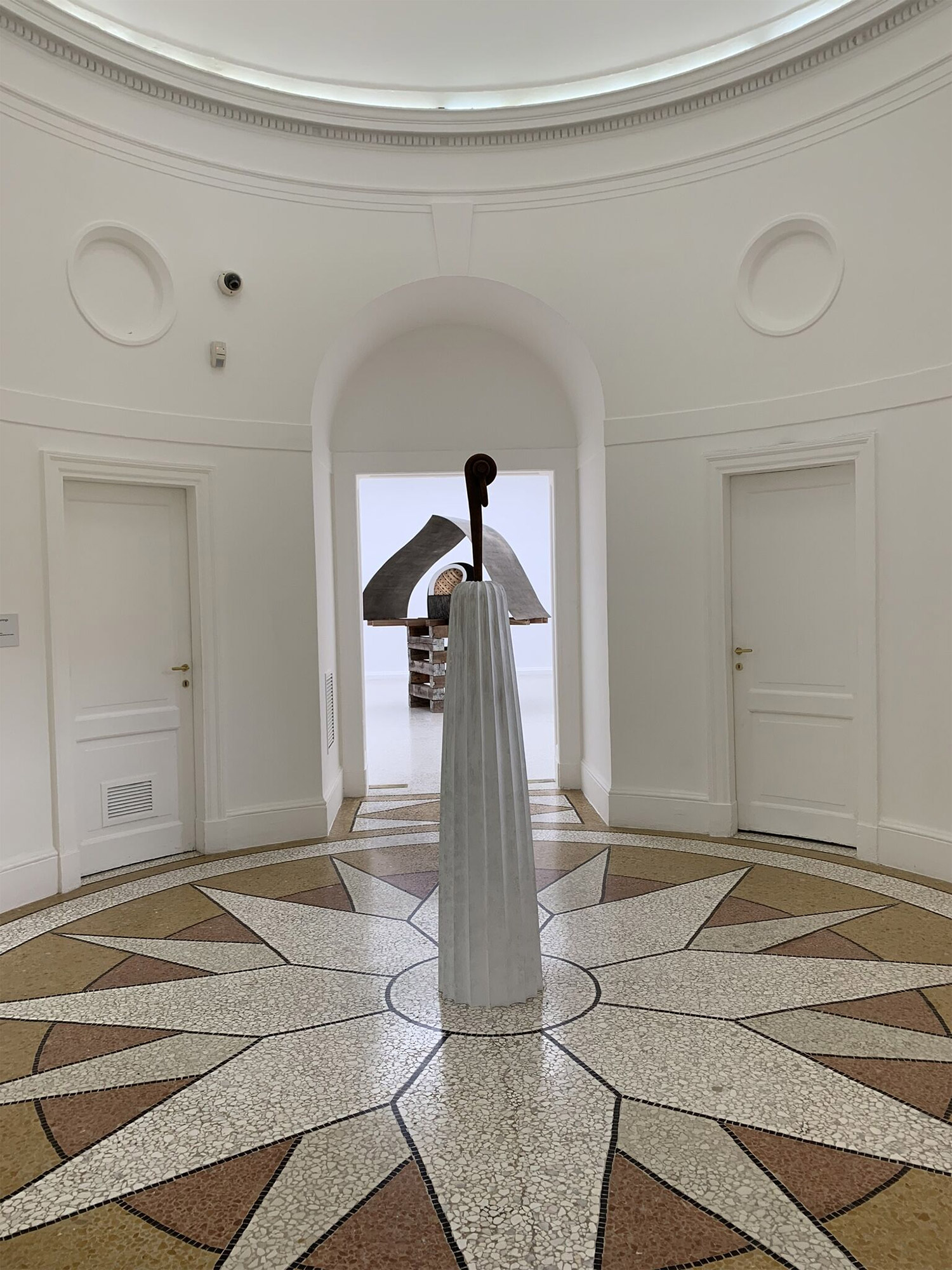
Image of A Column for Sally Hemings, 2019, with The Cloister-Redoubt or Cloistered Doubt? in the background.
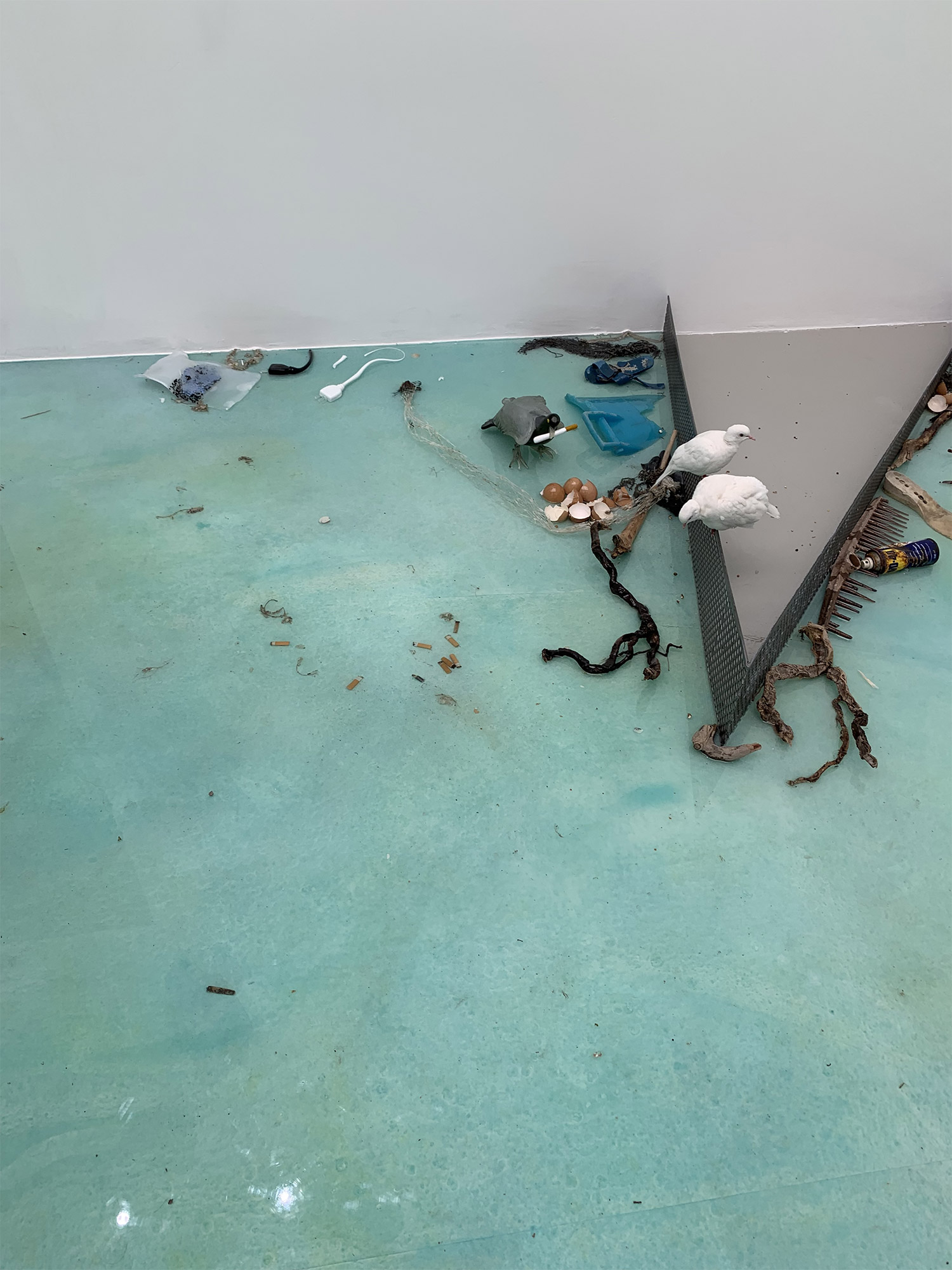
A Column for Sally Hemings, 2019, in the foreground, is dedicated to the African American slave owned by Thomas Jefferson, who was the father of her children. Puryear’s iron stake at the crown also destabilizes and offers a critique of the Pavilion built in 1930, on the Palladian principles of Monticello, Jefferson’s home, a slave. Puryear is not the first artist chosen to represent the US to critique the symbolism of its architecture. Puryear’s predecessor Mark Bradford in 2017 had garbage strewn in the yard of the Pavilion. One of the most memorable for me was that of Ann Hamilton’s myelin in 1999, who placed a veil of water glass that framed and distorted the image of the building seen through it. Inside the Pavilion, she had a fuchsia-colored powder sifting down the gallery walls, collecting on Braille dots that spelled out verse about human suffering.
Cloister-Redoubt has been characterized by Puryear as a meditation on the mystery of religious belief and a view of faith as an elaborately constructed edifice. Other objects in the Pavilion play on Puryear’s investigation of headwear, like the historical Phrygian cap or the aso oke (c) (2019). The latter is part of contemporary Nigerian dress and there is also reference to Yoruba textile and weaving.
There is no question that the intelligent elegance of the installation and the beauty of the artistic execution of the works made this Pavilion an artist’s, collector’s, art critic’s and curator’s choice. In conversation, an internationaly exhibited artist told me she thought that the US Pavilion was perhaps one of the best pavilions she had ever seen.
It made me curious to see how many times in recent history the US had actually had its Pavilion selected. Surprisingly, I found out that although the process was somewhat different in 1964, Robert Rauschenberg who represented the US Pavilion in 1964 was awarded the Golden Lion for painting. Critics stated that this signaled the end of European dominance of the art world, and further that it cemented pop art as a marketable artistic commodity. In 1988, Jasper Johns represented the US with Jasper Johns: Work Since 1974. Apparently this was taken as a statement that the US was still interested in participating in an international art world and hordes of collectors from the US arrived for the pre-opening festivities. He was awarded the Golden Lion for painting
Canada Pavilion – ISUMA
Isuma Collective
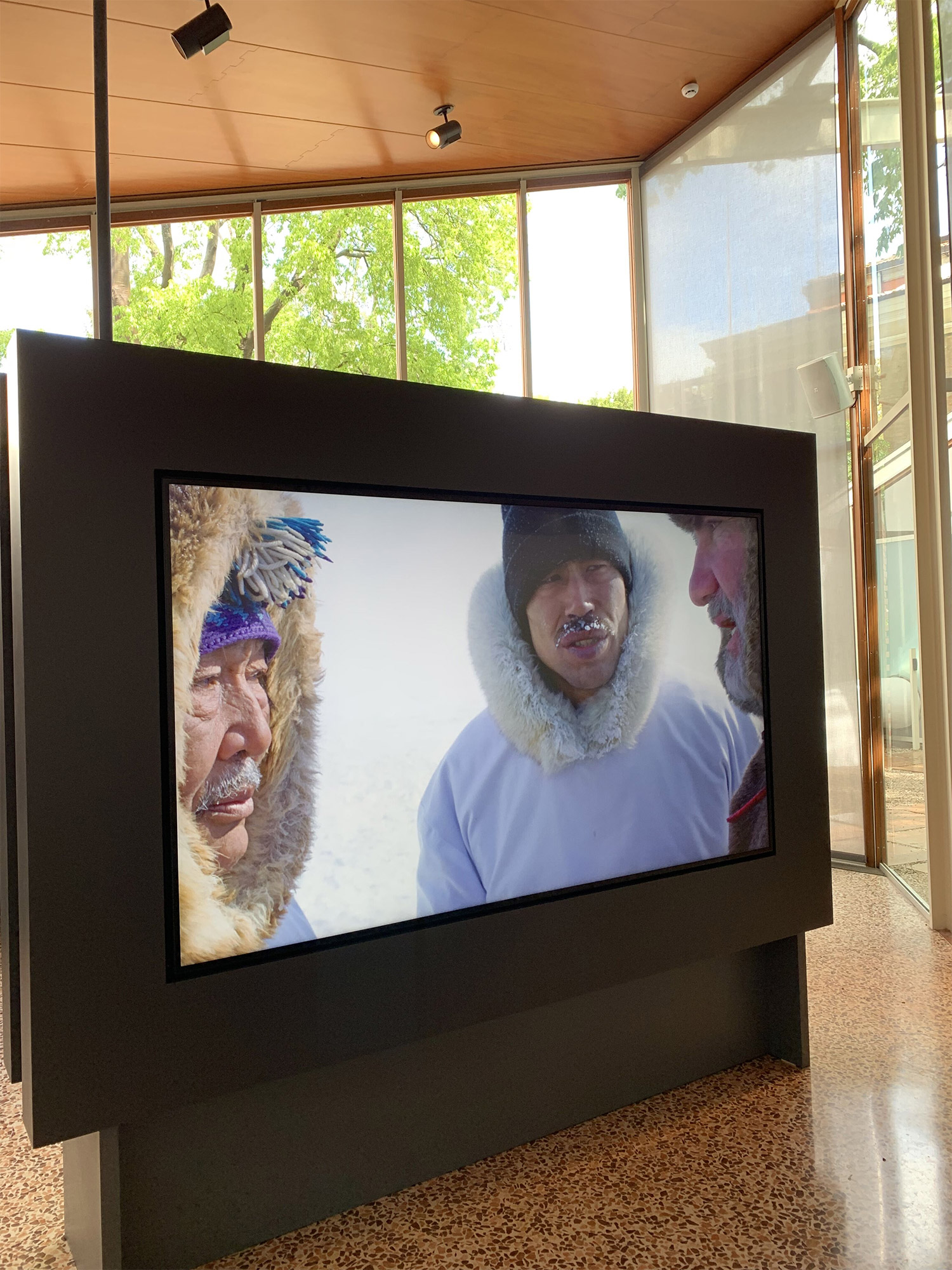
Artist collective Isuma, founded by Norman Cohn and Zachariah Kunkun, for the past two and a half decades has made films and videos in the Inuit experience. This marks the first presentation of art by Inuit in the Canadian Pavilion.
Consistent with the view that national pavilions represent the spirit and mood of a nation at that time, is the Canadian Pavilion. Few countries are as enlightened when it comes to the recognition of indigenous or First Peoples as Canada, notwithstanding that the Pavilion deals with episodes of mistreatment of the indigenous people of Baffin Island. The Isuma collective is made up of artists and indigenous people and has a mission of preserving indigenous language and culture, including through indigenous language TV. In a sense, the Pavilion shows artists who in one generation have gone from “the age of stone to the digital era.” Isuma means “state of consciousness” in the Inuktitut language. The International Exhibition artist who opined to me about the superiority of the US Pavilion commented when I had indicated my interest in Canada, “I am tired of National Geographic in a Pavilion.” I disagree. The exhibitions in the Pavilions of Brazil and Canada are not only appropriate because the events which they depict and the issues raised are at the center of current major legal socio-political debate, but also because the insight and talents of the artists take these out of the realm of ethnographic documentaries.
Interview with producer and writer of the film One Day in the Life of Noah Piugattuk
Installation view of the video One Day in the Life of Noah Piugattuk
Brazil Pavilion – Swinguerra
Barbara Wagner & Benjamin de Burca
Swinguerra is a film commission for the Pavilion of Brazil. In representing Brazil at the Biennale, filmmaking duo Barbara Wagner and Benjamin de Burca spotlit the underrecognized Swingueira dance groups of Recife, Brazil. Swinguerra takes its title from swingueira, a popular dance movement in the north-east of Brazil, fused with the word guerra, meaning war. The artists, Wagner and de Burca, worked out popular expressions of contemporary culture in Brazil and their complex relationship to race, gender, identity, and desire. The film provides a deep and empathetic view of contemporary Brazilian culture at a moment of significant political and social tension. The predominantly black bodies, many of non-binary gender, are in many ways “the focus of contemporary disputes around visibility, entitlement and self representation in Brazil.”
A clip from Swinguerra
France Pavilion – Deep See Blue Surrounding You
Laure Prouvost
Laure Prouvost is the third woman to be chosen for the French Pavilion after Anette Messager in 2005 and Sophie Calle in 2007. I encountered a young man of African descent at the entry of the Pavilion engaged in conversation with a journalist. When I asked him if he was the artist, he said, “No, it’s the other black man.” When I looked at him questioning, he said, “No, it’s me.” I told him I could interview him after seeing the Pavilion. Not knowing at that time the ethnicity of the artist who had been selected, I went through the Pavilion thinking that finally a person of African descent had been selected to represent France. It was interesting how it changed my perception of the experience of the Pavilion. On leaving, when I asked to speak to the artist, I was told that she had gone out for coffee. It turns out, the “artist” I had encountered was in fact one of the actors in Prouvost’s film. Unlike several of the other pavilions discussed in this article – India, Ghana, Mongolia and even the United States – Prouvost questions the concept of “national representation” and more broadly the question of identity.
Laure Prouvost
Belgium Pavilion – Mondo Cane
Jos de Gruyter and Harald Thys
This was a pavilion of parallel realities, which was awarded special mention by the jury.
Mongolia Pavilion – A Temporality
Jantsankhorol Erdenebayar (Jantsa) – an interactive sound performance by Mongolian traditional throat singers, accompanied by renowned German artist Carsten Nicolai, aka Alva Noto
Performance at Palazzo Grassi of artist and co-curator Carsten-Nicolai aka Alva Noto, with throat singers Ashit Nergui, Davaasuren Damdin,Altangerel Undarmaa and Damdin Khadkhuu
It is fitting, if art represents culture, the National Pavilion of Mongolia’s focus, in part, is on its intangible heritage. Mongolian ancestors that have traced back over 3 millennia have maintained a nomadic lifestyle where developments and the accrual of tangible creations, such as literature and art, were impeded due to the pastoral way of life, which required constant movement. Because of this limited context, oral traditions emerged and evolved as a principal means of expression and passed down through generations. With the progression of time, techniques of oral expressions acquired unique and complex forms. Originally, Mongolians practiced throat singing as a means of communicating with their inner selves, surroundings and animals. Sounds differed depending on the environment and evolved minds, bodies and spirits of the people emitting them. Throat singing was inscribed in 2010 on the list of the intangible cultural heritage of humanity by UNESCO under the convention for the safeguard of the Intangible Heritage (2003).
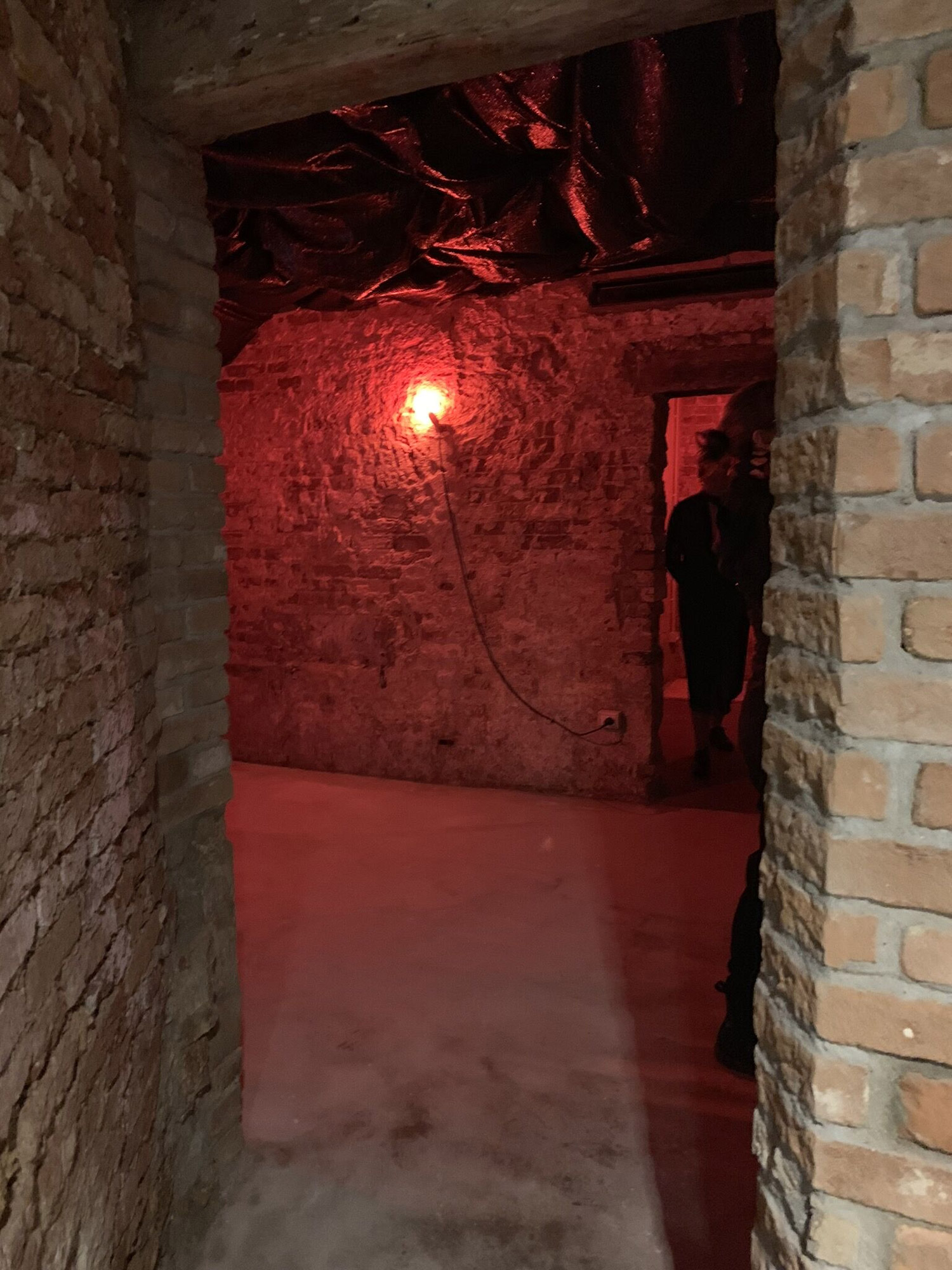
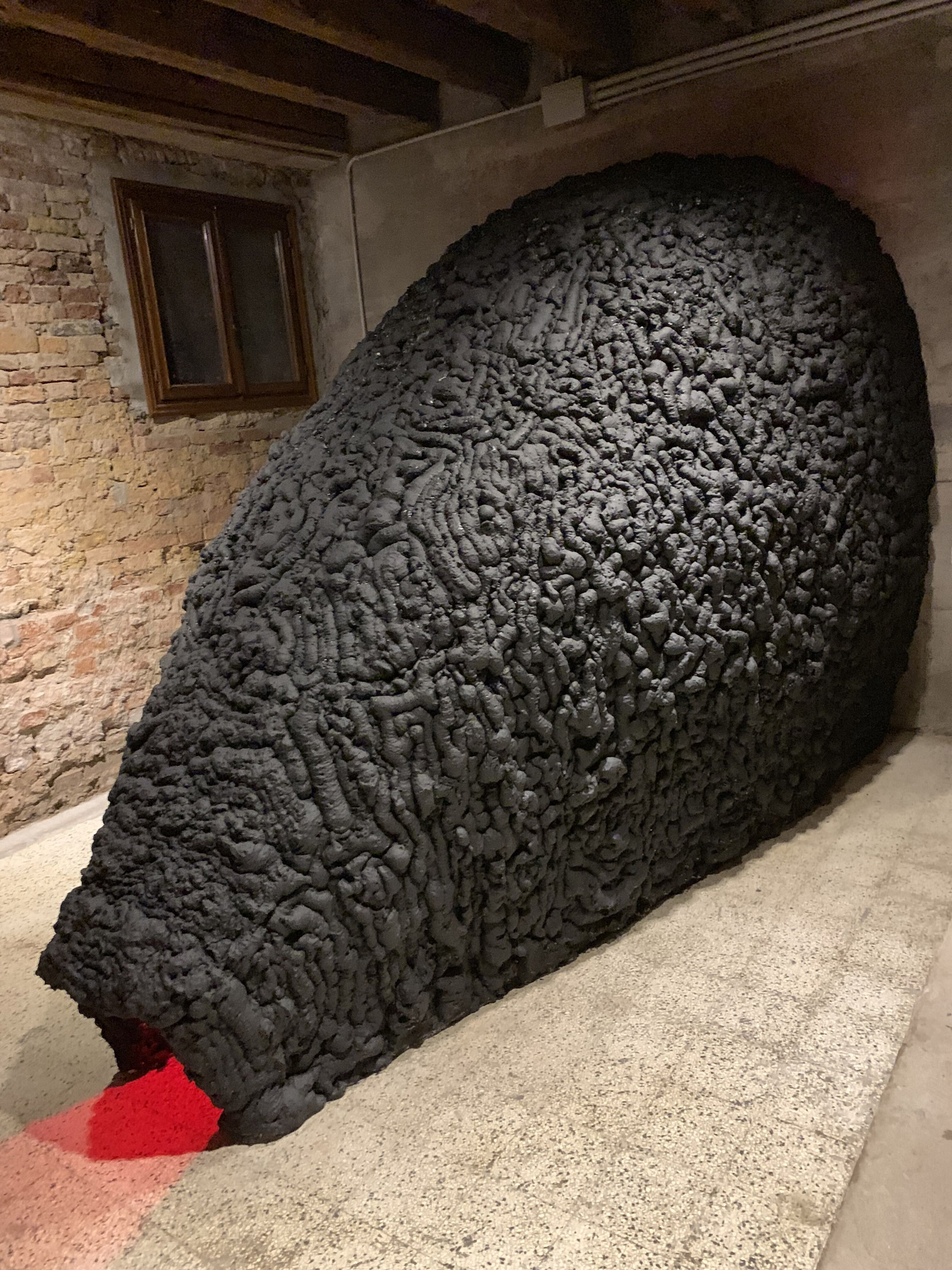
Curator Gantuya, who also organized the first and second editions of the Mongolian Pavilion, holds a degree in economics from Harvard and runs a contemporary gallery in Ulaan Bataar, commissioned the artist Jantsa to create sculptural installations to complement the brick-walled, interconnected cramped rooms of the old Venetian house. Jantsa’s sculptural pieces made of hybrid plastic and raw construction materials are created specifically for the Mongolian Pavilion. By juxtaposing contemporary works with the spirit of the old Venetian house, the sculptural installations of Jantsa offer viewers moments of fleeting forgetfulness and reminiscence where artists can interact with the space and objects with the form by emitting traditional throat singing techniques and electronic music. Jantsa, who has studied in the US, is nevertheless greatly aware of his roots and is intrigued by Mongolian tales, riddles, proverbs, and the intellectual communicative mindsets that have occupied his nomadic ancestors. Jantsa pays homage to the sculptors Ursula von Rydingsvard and Nari Ward, who recently had his first long overdue solo retrospective show We the People at the New Museum in New York, imbued with the magic and power which has previously inspired Jantsa.
Jantsankhorol Erdenebayar
Jantsankhorol Erdenebayar
Jantsankhorol Erdenebayar
The Mongolia Pavilion is located outside the Arsenale. Walk past the Arsenale entrance turn right over the bridge and you will find it, as well as Pakistan.
Ghana Pavilion – Ghana Freedom
Ghana’s first pavilion at the Biennale was much heralded. The Pavilion brought together Ghanaians from the diaspora as well as a younger generation of Ghanaian artists. It was a celebrity artist pavilion designed by celebrity architect Sir David Adjaye O.B.E., known in the US for being the architect of the National Museum of African American History and Culture (I was on the selection committee for what was then the Faith Ringgold Museum for Art and Storytelling in Harlem, which selected Adjaye for his first US project). The Pavilion includes an amazing three-screen video installation by John Akomfrah (1952) the noted pioneer filmmaker and artist who was a founder of the influential Black Audio Film Collective in London in 1982; large scale drape sculptures by El Anatsui (Golden Lion for lifetime achievement 2015); a large video/sculptural installation by Ibrahim Mahama, a younger generation Ghanian artist (1987) who uses the transformation of materials to explore themes of commodity, migration globalization and economic exchange; a video installation by photographer and glass artist Selasi Awusi Sosu (1976); portraits and photographs by Felicia Abban (1935), a true discovery with photographs much in the same genre as Malien photographers Malick Sidibé and Seydou Keïta, Lynette Yiadom-Boakye’s (1977) paintings are a tour de force. The advisor for the Ghanaian Pavilion was Okwuchukwu Emmanuel Enwezor (1963-2019) to whom the catalog of the exhibition is dedicated. Consistent with one of the themes of this article, a catalog essay by Taiye Selasi, of Ghanaian Nigerian origin, “Who’s Afraid of a National Pavilion?” posits the question “if the National Pavilion is so problematic – anachronistic at best, imperialistic at worst – why would any nation want one? Why would Ghana? What business has a post-colonial nation with a biennial based on colonial nationalism?” The answer posed is that “to the curator and the artists of the Ghana Pavilion take precisely that control, illuminate the complexity, flexibility, and multiplicity inherent in the notion of Ghana itself. Here we find Ghanaian creators involved in the project of imagining not a Ghanaian self, but Ghanaian selves; and doing so exultantly, unapologetically under the banner of nation.” And further, she provided as one answer “to give Ghanaian artists, whose relationship to nation and self we allow to be opaque, the space to perform their interrogations on a global platform they deserve.”
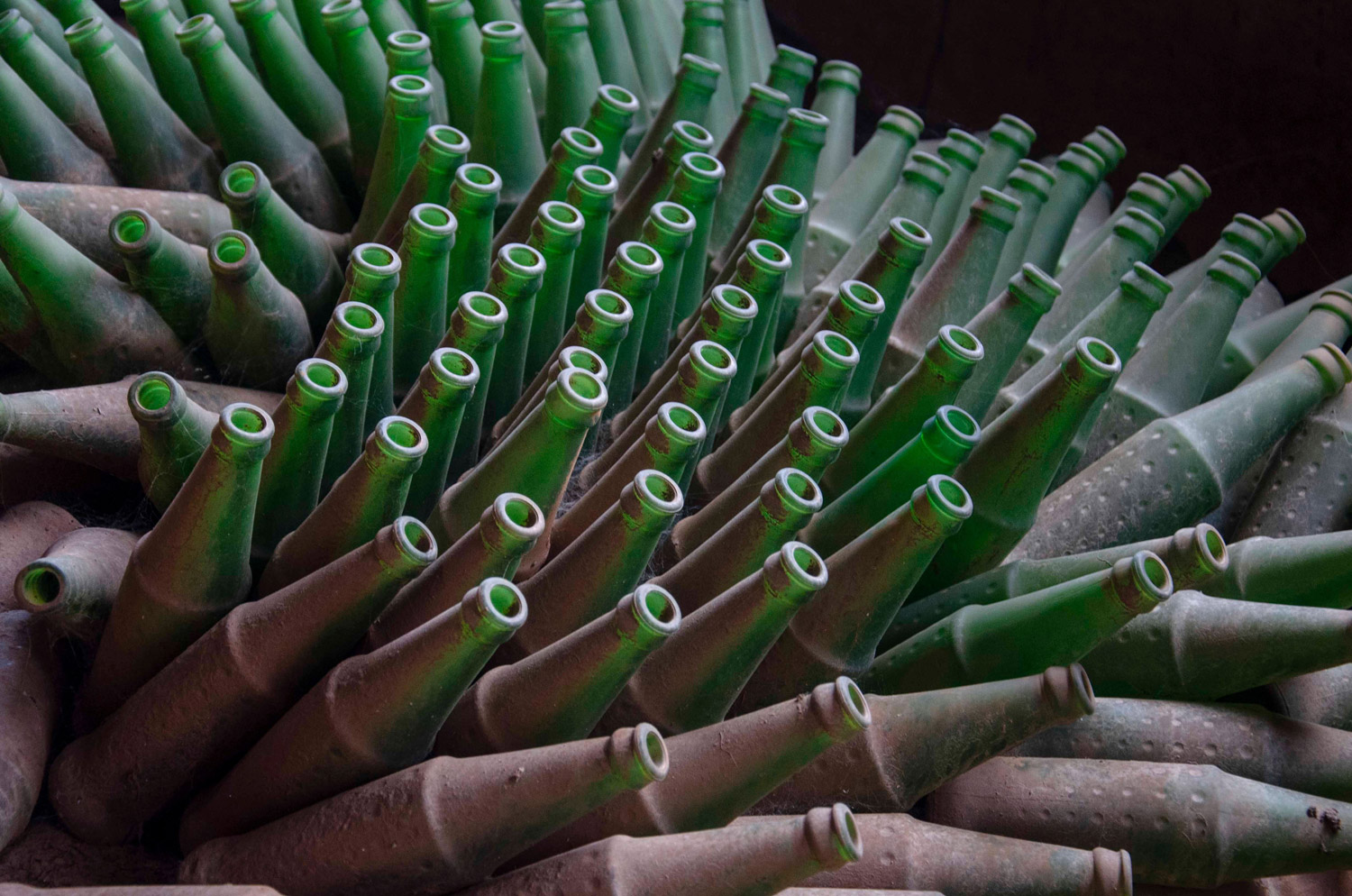
At the opening of the Pavilion, I had the opportunity to interview , Selasi Awusi Sosu. Sosu’s Glass Factory II, 2019, was inspired by desolate and defunct state-owned industrial glass manufacturers in Ghana’s Western region. In its prime the factory provided a livelihood for thousands of Ghanaians. Sosu visited the abandoned site on numerous occasions seeking to capture transient and past moments. She interviewed former employees of the factory who revealed a nostalgia for the past because many of them have since resorted to illegal small-scale gold mining which, unfortunately, processes gold by using mercury, detrimental to their health, the community and the natural environment. When I talked to Sosu, she indicated that being in Venice was more than a dream come true not only because she was participating in the Ghanaian Pavilion but also because she had tried unsuccessfully to work in glass in Ghana without much success. It was in fact a dream for her to envision working in Murano and learning how to use her envisioned medium of artistic expression.
I had the opportunity to speak with Selasi Awusi Sosu
Selasi Awusi Sosu, Aboso Glass Factory, (c) 2017
Selasi Awusi Sosu, Glass Factory II (Film still), (c) 2019
Selasi Awusi Sosu, Glass Factory II, (c) 2019
Selasi Awusi Sosu, Focus Gold, (c) 2014
India Pavilion – Our time for a future caring
India has a long history but it has taken the Indian art and cultural community quite some time to unite on the presentation of an Indian Pavilion at a Biennale. The curated presentation is a call to understanding Mahatma Ghandi’s ideas in commemoration of his 150th birth celebration. The Pavilion weaves together contemporary artworks by eminent artists – Nandalal Bose (1882) (Haripura Posters 1937), MF Husain (1915), Atul Dodiya (1959), Ashim Purkayastha (1967), Jitish Kallat (1974), GR Iranna (1970), Rummana Hussain (1952), Shakuntala Kulkarni (1950) – emphasizing historical moments concerning Ghandi or invoking critical thinking in imaginary staged encounters. As the Indian Minster of Culture, Arun Goul stated, Secretary Ministry of Culture, “Mahatma Ghandi’s life was his message… Ghandian values have always been an intrinsic part of the Indian ethos. Art is nothing but an expression of a nation’s culture. The installation and artworks at the Indian Pavilion are an expression of the universal Ghandian values of truth, nonviolence, compassion towards fellow beings and nature, self-reliance, simplicity and sustainability.”
GR Iranna, India Naavu (We Together), (c) 2012
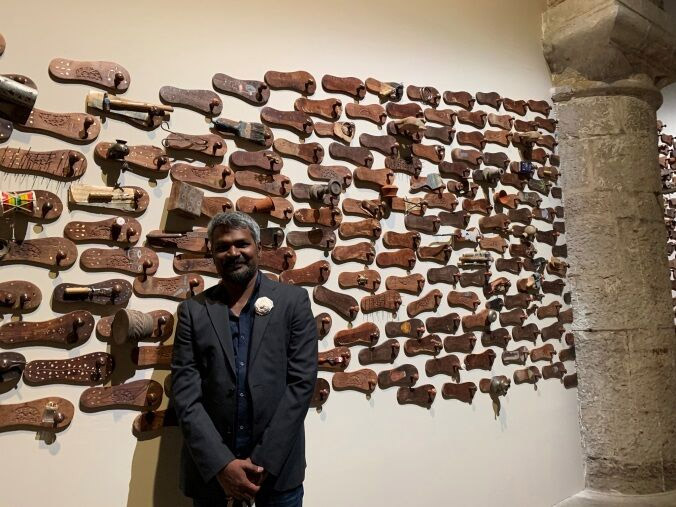
Having migrated to New Delhi to study and practice art more than two decades ago, Iranna reflects on the atrocities of an increasingly brutal world, critiquing forms of violence, also appealing to resist provocations and unnecessary aggression.
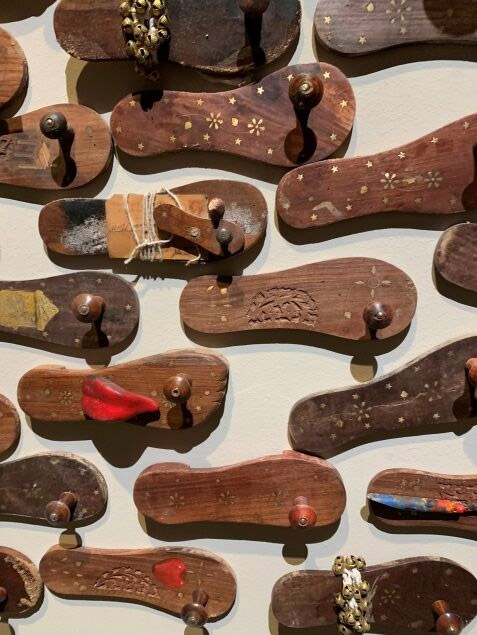
In recent years, Iranna has taken to working with the unpredictable medium of ash, engaging with the ephemeral, with marks and traces and the dematerialization of matter. Subsequently, he has worked with commonplace objects such as padukas, or Indian slippers traditionally made of wood, associated since antiquity with spirituality and reverence. Doing away with Gandhi’s widely identifiable eyeglasses, the spinning wheel or walking staff, Iranna turns to a less referenced object-symbol. Ghandi’s padukas (indicative of his adherence to non-violence in the rejection of leather) allude to his idea of Satyagraha (passive political resistance), attained through the collective mass action of walking/marching. Gandhi, it is believed, in the forty years of his active political life, on an average, walked twenty kilometers every day.
Naavu (We Together), (c) 2012
Naavu (We Together), (c) 2012
Chile – Altered Views
Voluspa Jarpa
The project is a result of years of research into the reality of Latin American countries through CIA declassified documents. It is composed of three reversed cultural spaces/models: The Hegemony Museum, the Subaltern Portrait Gallery, and the Emancipating Opera. Voluspa Jarpa is the first woman to represent Chile at the Biennale.
Lithuania Pavilion – Sun & Sea (Marina)
Rugilė Barzdžiukaitė, Vaiva Grainytė and Lina Lapelytė
“Art is not a message that we can simply decipher and comprehend; indeed, interesting artworks do not offer us conclusions so much as deeply engaging points of departure. They provide unexpected pleasures and a residual sense of surprise and uncertainty; we might end up feeling that we simultaneously understand and do not understand them.” Ralph Rugoff said, “May You Live In Interesting Times.” This quote is indeed apt for the winner of the best Pavilion. A number of national pavilions might have received the Golden Lion, however the selection of Lithuania, funded by a Go-Fund Me campaign, cannot really be questioned. “The piece has to do with ecological issues and the Anthropocene,” Grainytė said. “But I didn’t want to be didactic because it’s such a big topic and it was important to find a subtle, romantic language.” My friend Yates Norton, a curator of a space in Lithuania and a collaborator and artist in the Pavilion talked about the challenge deliberately imposed of the eight-hour performance schedule.
As someone interested in opera and performance, I agree, it was really quite brilliant. Coincidentally, I learned Lithuania has won four other recognitions since its participation in the Biennale. Not only was I privileged to attend the performances before the announcement of the award, I subsequently learned that Performa’s gifted former curator and co-curator of the next Gwanju Biennale was also member of the jury that awarded the prize to the Lithuanian Pavilion. Given last year’s award of the Golden Lion to Anna Imhoff’s installation, Faust, in the German Pavilion, and the addition of performances during preview week as a collateral event, it seems visual performance art has been recognized as an important medium of expression in international contemporary art.
Unfortunately, for non-preview week visitors, the eight-hour opera performed by the beachgoers will only occur on Saturdays.
Rugilė Barzdžiukaitė, Vaiva Grainytė and Lina Lapelytė, Sun & Sea. Vocals in this clip by Yates Norton
Taiwan Pavilion – 3X3X6
Shu Lea Cheang
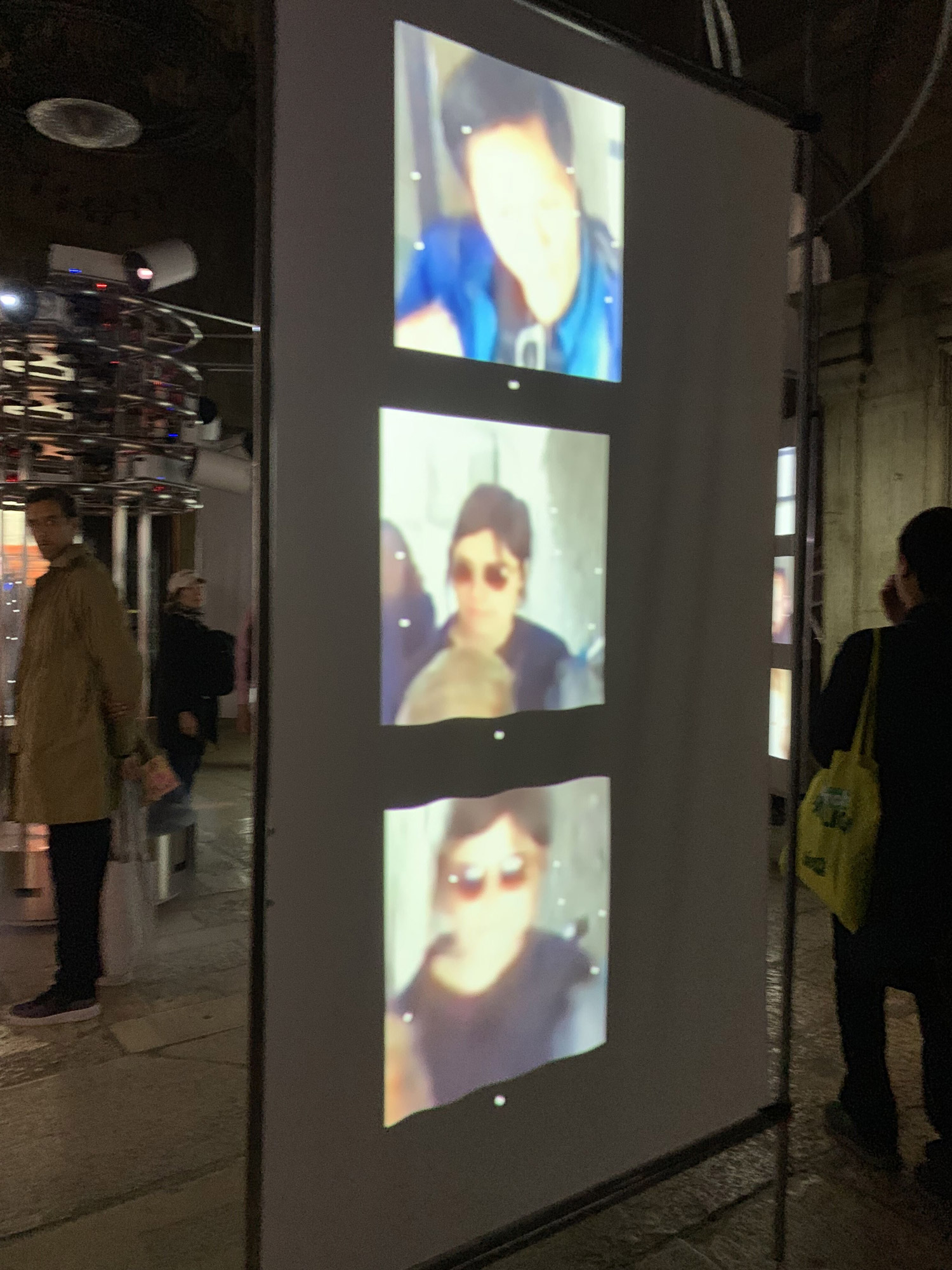
Giacomo Casanova said, “One who makes no mistakes, makes nothing.” Reflecting upon the transformation of surveillance techniques since the panopticon to include contemporary 3-D facial recognition, AI, and the Internet, Shu Lea Cheang’s 3X3X6 restages the rooms of the Palazzo delle Prigioni — a Venetian prison from the sixteenth century in operation until modern times — as a high-tech surveillance space.
The Taiwanese Pavilion for me was one of the most forward-looking, creative and intellectually interesting. The complexity of the imagery and the ideas cannot be easily transmitted in this article. By way of illustration, some of the subjects addressed in various video and imagery include (i) the inverted electronic panopticon, (ii) Cassanova in pharmacopornographic times, (iii) Sade and the social contract in the age of sexual cyborgs, (iv) Foucault in Warsaw, and (v) the myth of the non-white rapist. As the curator Paul B. Preciado wrote in the catalog, “hacking digital surveillance technologies and social media, Chaeng uses the historical site of the Venetian renaissance prison to create a real time dissident interface that the visitor is invited to enter… whereas modernism negotiated the tension between craft and the emergent technologies of its era, the digital avant garde develops out of the reassessment, critique and collapse of modern aesthetics by post-internet technologies including data mining and mass surveillance. This digital avant garde movement undertakes two oppositional moves: one, Chaeng uses and misuses the possibilities of producing and distributing art specific to the internet; and second: She questions the hegemonic narrative that criminalizes sexual, gender and racial minorities… the norms that have established the difference between the normal and the pathological, the real and the virtual, the socially recognized and the invisible.”
3X3X6
3X3X6
Iran Pavilion – Of being and singing
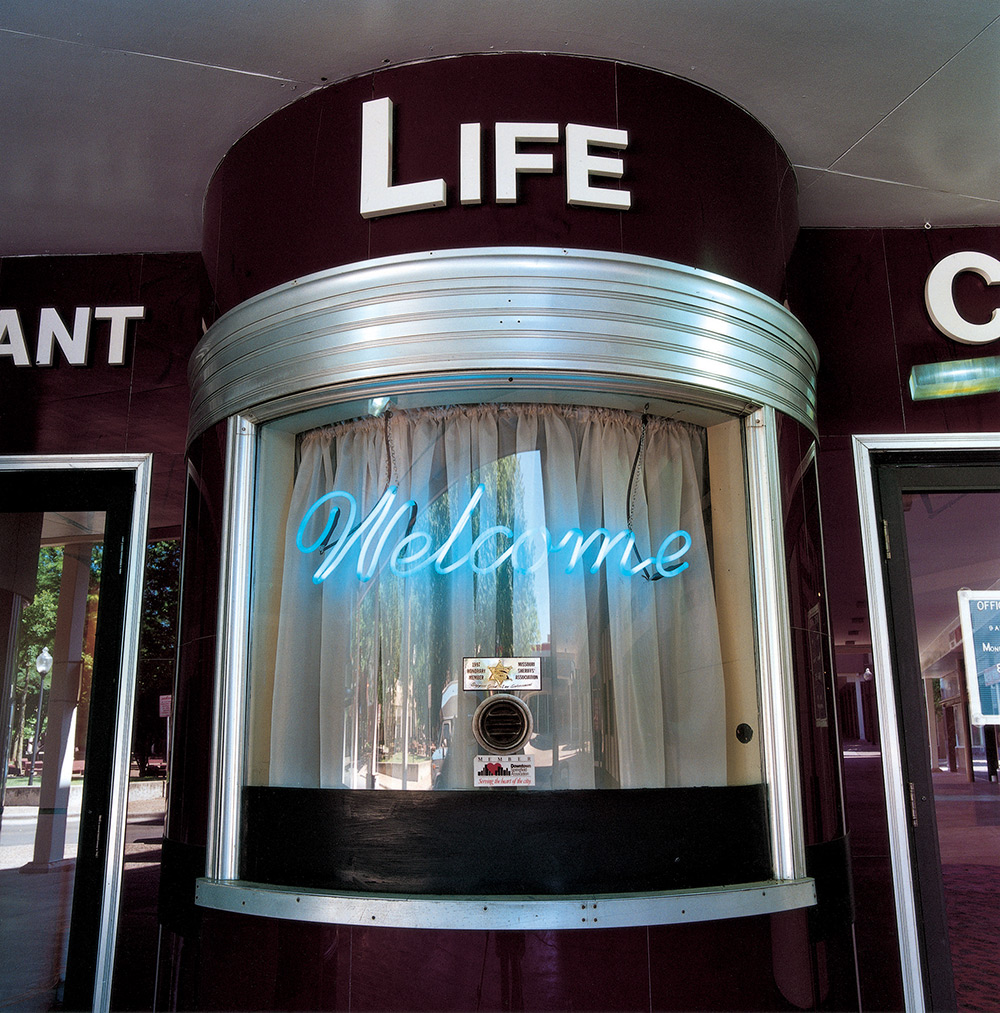
The Iranian Pavilion, located off-site in a house at Fondanco Marcello, is an exhibition of three artists, two from Tehran, Reza Lavassani (1960), Samira Likhanzadeh (1967) and Ali Meer Azimi (1984) who lives and works in Esfahan. The curator of the Pavilion states that it is “an homage to life and to precious moments of the past, present and future. The exhibition carries a message of piece from the cultural and artistic scene of Iran, a message seldom relayed to the world by contemporary media. Representing Iran are three artists hailing from various disciplines who magnify the glory of being and kind, identity and memory, reality and dreams. Challenging the clichéd notions of Iranian art as mostly composed of local elements and motifs, these artists represent the universal aspects of Iranian art through their artistic terminology.” The banner which begins this article is “life.” Through a deliberate choice of paper maiche, the artist underlines the literal and symbolic significance of recycling and portrays the artist’s belief in recreation and the eternal cycle of life. For more immersion in contemporary Iranian art, visit The Spark is You: organized by Parasol Unit, London, curator Ziba Ardalan, in the Conservatorio di Musica Palazzo Pisani Campo Santo Stefano. The collateral exhibition brings together 9 Iranian artists of different ages, like Siah Armajani and New York-based YZ Kami, who now live and work the US with those working in Iran, who have had a similar early education and grounding in classical Persian poetry.
Reza Lavassani, Life (c) 2015
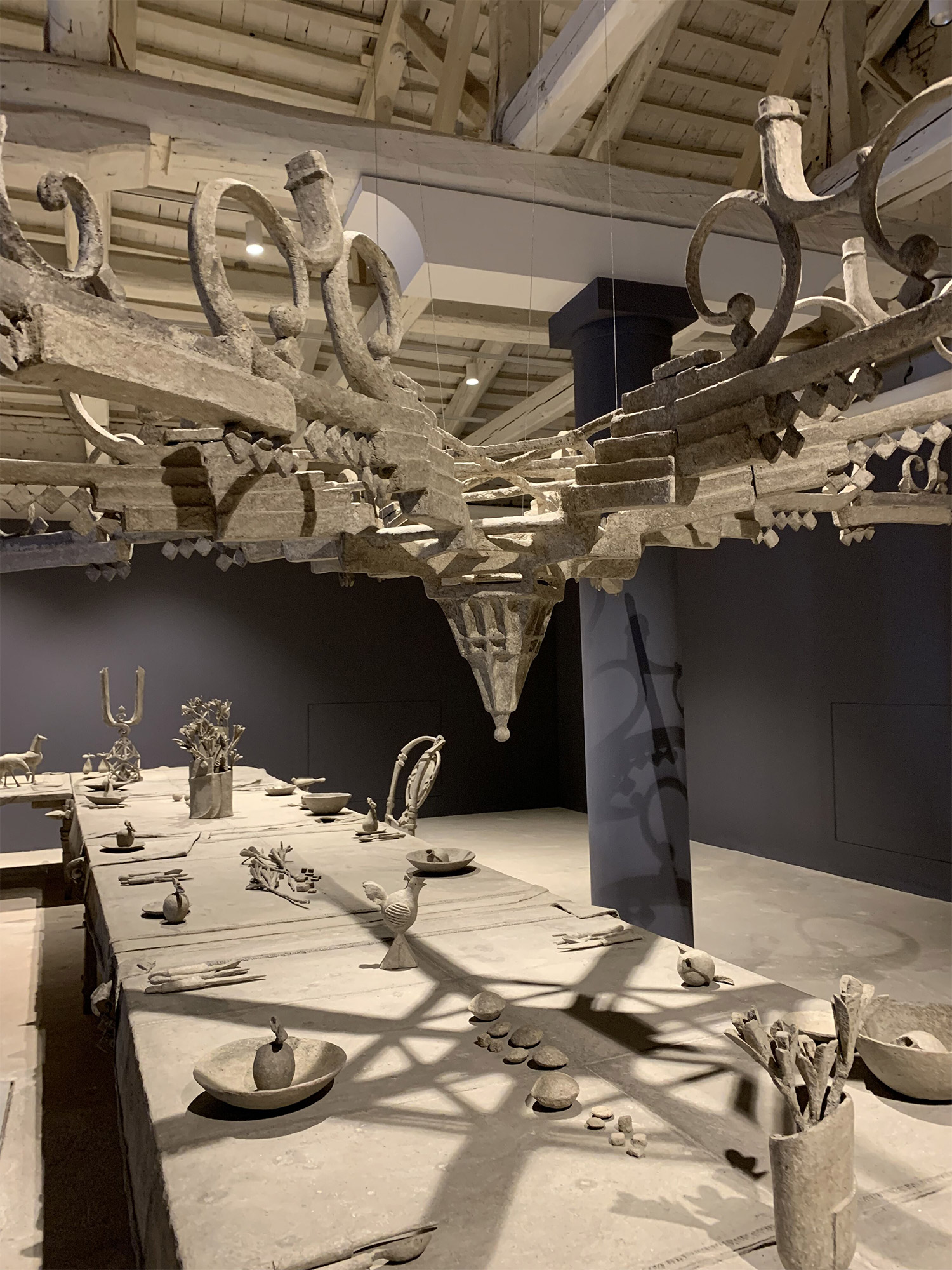
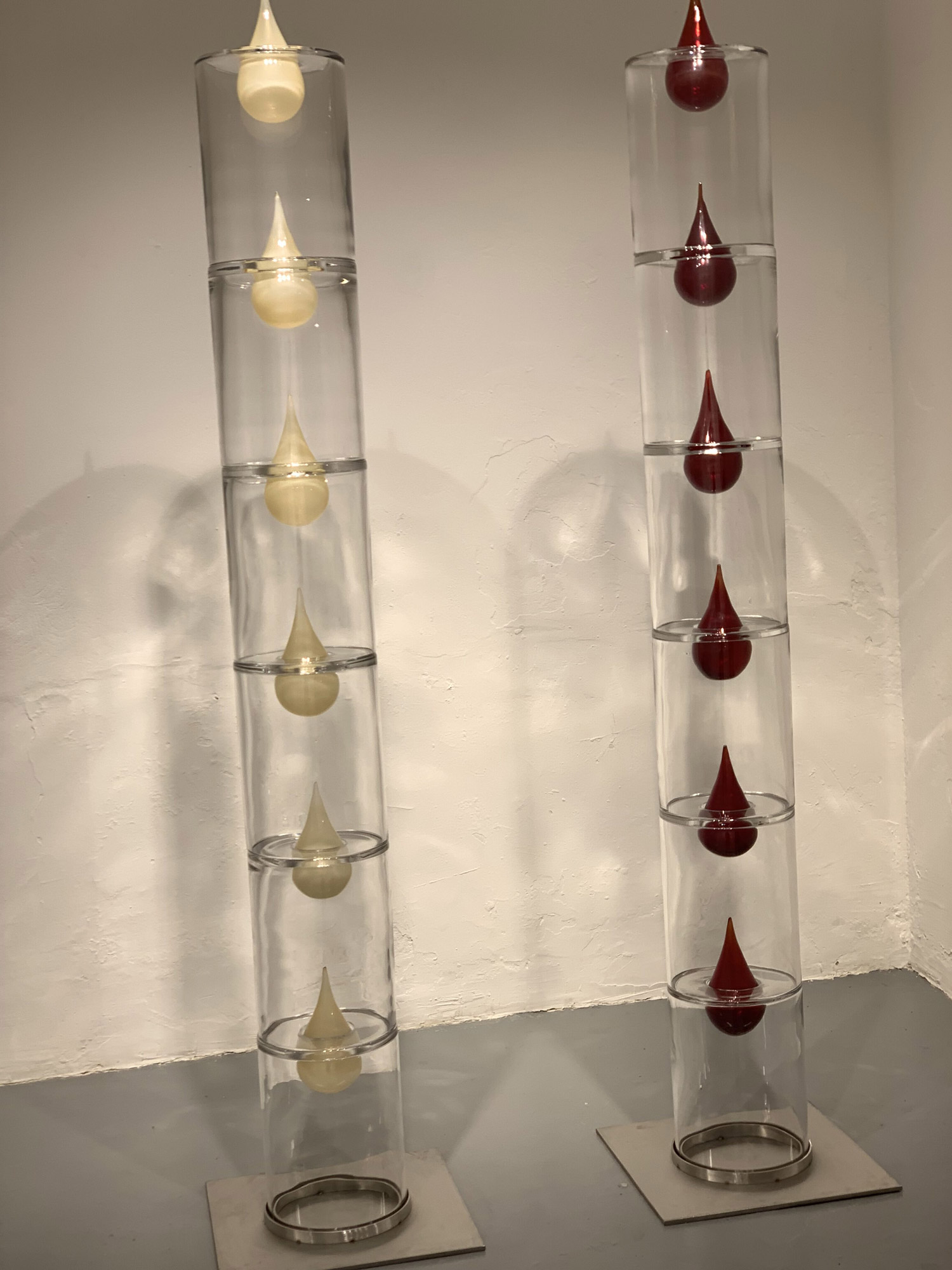
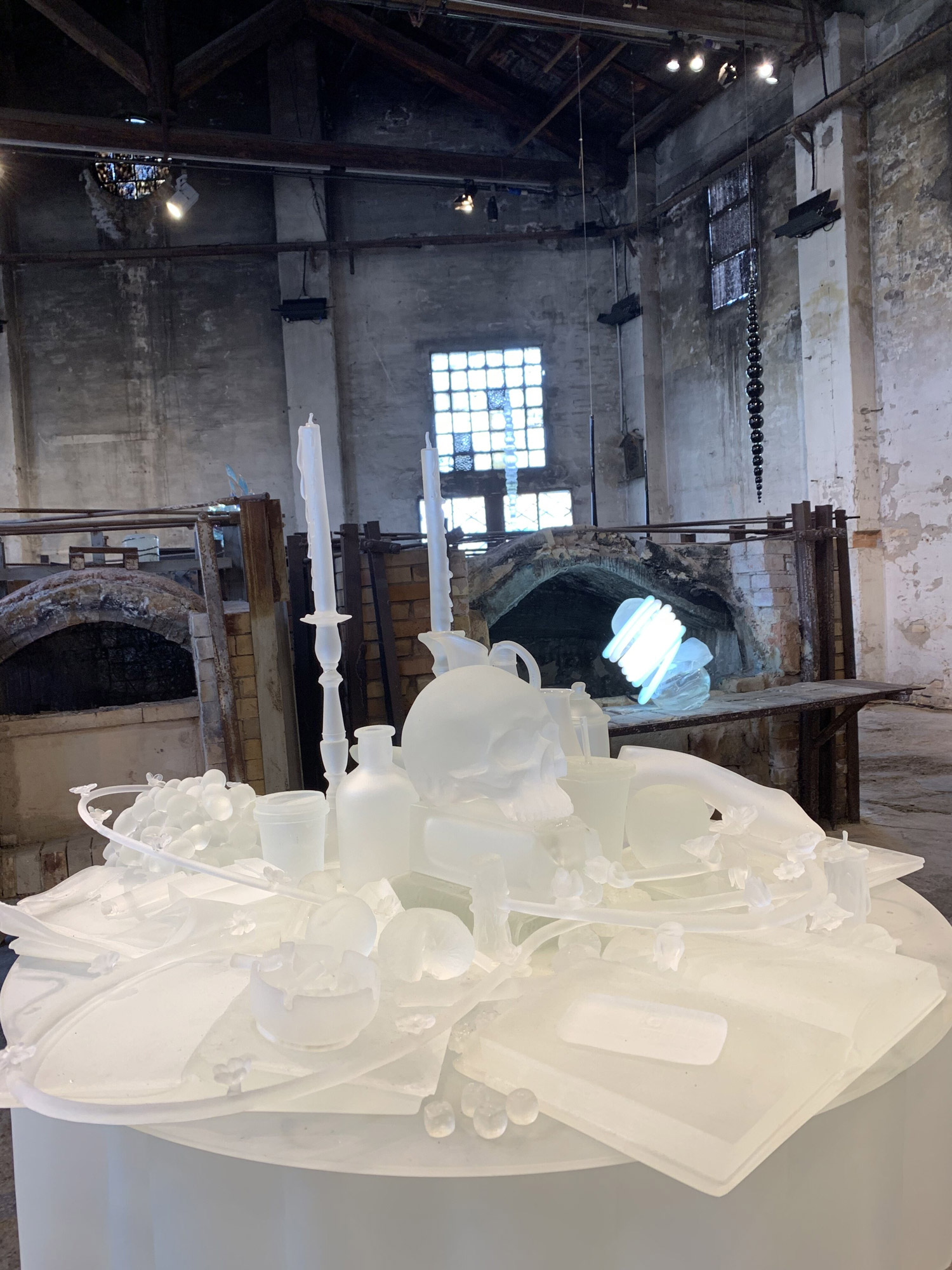
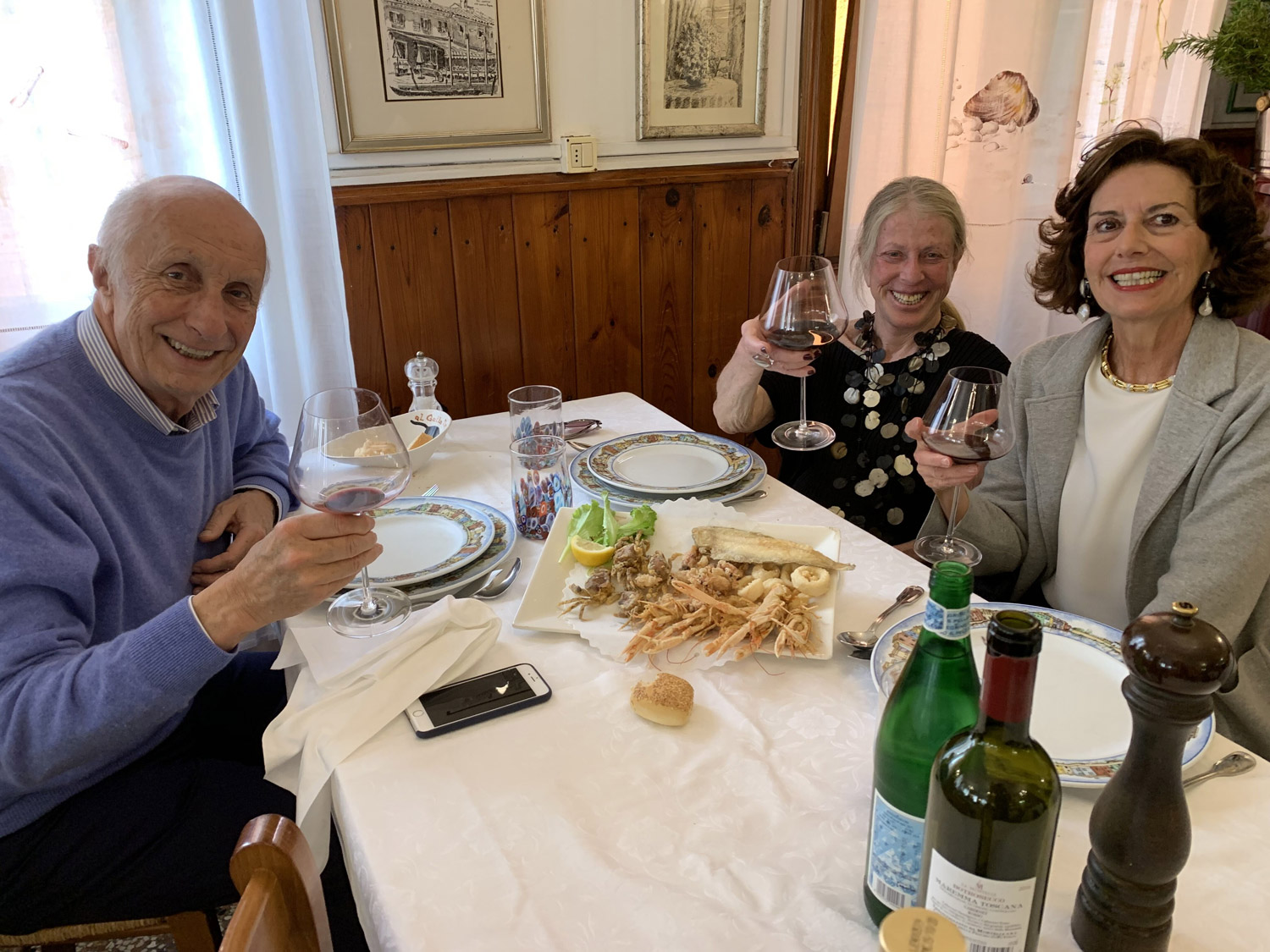
After five intense days of biennial events in Venice, it was refreshing to take a break to visit Murano. A quick vaporetto ride from near San Marco, I visited Glasstress, an exhibition curated by Vik Munez and Koen van Mechelen, artists include Carlos Garaicoa, Aiweiwei, Jaume Plensa, Sudarshan Shetty and Fred Wilson, among others. In its sixth edition, the exhibition for me was less interesting than two years ago and the space a bit crowded. Notwithstanding, there were some interesting works. Even more fun was to take another vaporetto for a twenty-minute from Murano ride to Burrano and relax with a marvelous, typically Venetian seafood luncheon at Il Gato Nero. My Italian friends shared a valuable tip: Buy the app Che Bateo, instead of Goggle Map for vaporetto time tables and GPS.
This month, our featured member is a speaker and a licenced sport pilot. Oh and we should also mention that he is a self-taught photographer whose career started at age 20. He quickly became one of the youngest high-profile photographers in the world and has worked with President Barack Obama, Lady Gaga, the Dalai Lama and others. Let’s see what else we can find out about Jon Carmichael!
Tell us about the trajectory of your career up to this point.
I actually never meant to be a professional photographer, so it’s funny how my career path has unfolded. I taught myself how to use a camera when I was 20 as merely a hobby. For almost ten years I never showed anyone my artwork or even printed a single photograph. Then my father passed away and everything changed. I had many regrets of not sharing my work with him, so in his honor I spent a year learning the printing process and created my first artist proofs. Through this miraculous grapevine, as if it was fate, the day I finished my first proofs Elton John, one of the biggest collectors of photography, heard my story and invited me to his home to see the prints. He became my first collector, encouraged me to share my work and introduced me to the art world.
Who are your biggest influences?
I tend to find most of my inspiration through philosophers, scientists, and entrepreneurs. Carl Sagan was my biggest influence growing up and is the reason I became curious about astronomy, which later evolved into my passion and career of being an astro-photographer. Other influences are Buckminster Fuller, The Dalai Lama, and Elon Musk.
What does your work aim to say?
I try to tell a story with my work and instill curiosity. To me, there’s nothing more mysterious or awe-inspiring than the universe and natural beauty of our planet. It’s very humbling. Unfortunately we have too much light pollution now due to electricity. Because of this, we cannot see much of the night sky and have lost our sense of awe and wonder that our ancestors had. I try to reignite that in my work. What I love most about photography is being able to push the boundaries and unveil parts of reality we cannot see with the naked eye.
Bonus Question: What tip would you give our members about collecting photography?
We as humans are social creatures and storytellers. I would encourage members to collect works that have a story which move you personally – something that has meaning and is not just aesthetically pleasing. Anything can be photographed beautifully, but it’s often the story behind it that gives it true value. If you’re walking through an art fair or gallery and a photograph stops you in your tracks, I encourage you to ask more about the image and the story, as it might surprise you.
And this is why we love our “Get To Know Our Members” feature… we have so many inspirational members, whom we are so proud of, just like Jon! Please find more of his work here. Next month, we’ll select a new member to feature… it could be YOU!
Today we chat with Tina Ziegler, Director of Moniker Art Fair, who has been at the progressive forefront of the urban and new contemporary art scene since 2010. Having curated well over 100 exhibitions across countless countries, and in doing so introducing collectors and art lovers to thousands of artists, she acts as a leading authority within the scenes, heading Moniker as a hub for new art movements while continuing to operate on the fringe of the industry to ensure that boundaries continue to be pushed.
In 2018, she expanded the previously-London-centric fair to New York, introducing new context and a new dimension to the already-renowned, stylistically eclectic and trendsetting event.
First of all, congratulations on the 10th year anniversary of Moniker Art Fair! Can you please give us a quick version of the history of the fair?
Moniker started 10 years ago to fill a gap that was notably missing in the scene: a platform for truly pioneering urban contemporary art, and specifically art that had something to say; a message worth amplifying. We’ve grown from there to two fairs a year in London and NYC, additional smaller events throughout the year, and more international potential unlocking as we speak.
Why did you decide to take the London-based model across the pond to NYC and what will the similarities and differences be between the two fairs?
Like London, there’s a very strong collecting scene in NYC, and like London there’s an enthusiasm, a willingness to come out to something new or different. Having said that I think you can push boundaries more in New York, perhaps because it’s a key birthplace of urban art, so you can take each step forward in their stride. It also means you can start to engineer retrospectives of the city’s relationship with urban works, as we’ll be doing with WK Interact this year.
Similar to One Art Nation, you recognize the importance of creating transparency in the art market. How are you achieving that through the fair?
We’ve always tried to create strong open dialogues between the collectors, the artists, the gallerists and the fair itself, and that’s the crux of how we create the transparent environment, I think. We need to be honest with ourselves about the appetite for art, the way artists are treated and encouraged and actually the way collectors are treated and encouraged. All we can do in that sense as a fair is to listen to what the community needs and programme the fair around those needs. It’s not rocket science, but it’s notable how easy it’s been for the art fair industry to assume it can just do whatever it wants and collectors will hand over their money. We can think bigger than that; we should.
How is Moniker a truly unique experience for art-fair-goers, especially in a climate so full of art fairs?
Our installations are something particularly unique, I think, and that’s perhaps because of the lineup we curate each year. We’re working with hyper-relevant ideas, modern contexts, and crucially good art. Contemporary art has an almost unfair level of scrutiny to it because it’s not enough to provide striking social commentary, it’s not enough to be a good artist, it has to be both. And we provide that to a unique level – we listen carefully to the scene and bring the best of that emerging talent to the forefront, but we’re also connected enough to go to more established, critically acclaimed artists and say “what would you do if we gave you a lot of space to create something unique in?” They rise to the challenge astonishingly and it’s always gratifying to see our collectors and audiences react to the spectacle of the whole thing.
What role do art fairs play in the overall global art market today?
We have a lot more responsibility than I think many realise. Collectors want to take advice from the industry, they want to know who they’re buying and why, and not just because something is on-trend this year. We decide who they care about, and that means fairs are essentially kingmakers, so we need to be careful and thoughtful about who we’re putting to the forefront of the industry, and crucially who we could be missing. It’s why we take our curation seriously.
This month, our featured member is both an Art Advisor and Portfolio Manager from Barcelona based in London. Please meet Marc Sancho, whose life changed when a few months before enrolling in the army, a rugby injury led him to discovering Art and Philosophy. Since then, love – in all forms – has driven his career towards helping people manage their art collections. Marc expands on what he does, how he got there and what he would say to an aspiring art advisor.
What do you do in the art world?
As a Collection Manager, I basically love to help educate the tastes of collectors, manage the constant outcomes of an art collection and buy or sell on behalf of my clients to get the best deals (and returns). This work gives my clients the space to just focus on enjoying their art collections – I look after the rest. Through Art & Axia, every job I do is unique and depends on the needs of my client.
Did you receive any education, training or mentorship that has helped you excel in your career?
Indeed… I have two university degrees, several specialized courses (in arts and investments) and a Master in the Art Market up my sleeve. But I don’t think I would be where I am today, if it weren’t for my mentors in the auction house that I worked at early in my career in Barcelona. My mentors taught me not just the ins-and-outs of the profession, but to read between lines.
What are the most interesting—or most challenging—aspects of your work?
I truly enjoy sharing my passion for art with my clients; most of them are as passionate as I. It is absolutely magic when (after months of scrupulous research, Excel spreadsheets full of numbers and graphics and dealing with international paperwork), we finally purchase a piece they love.
Any words of advice for emerging professionals trying to make it in the art world?
Being an independent art advisor means you are a One-Man-Band, so you have to prepare yourself in different fields. In addition to strong critical skills and sensitivity towards art, it is also necessary to have a deep knowledge of the laws, economics, languages, logistics, etc.
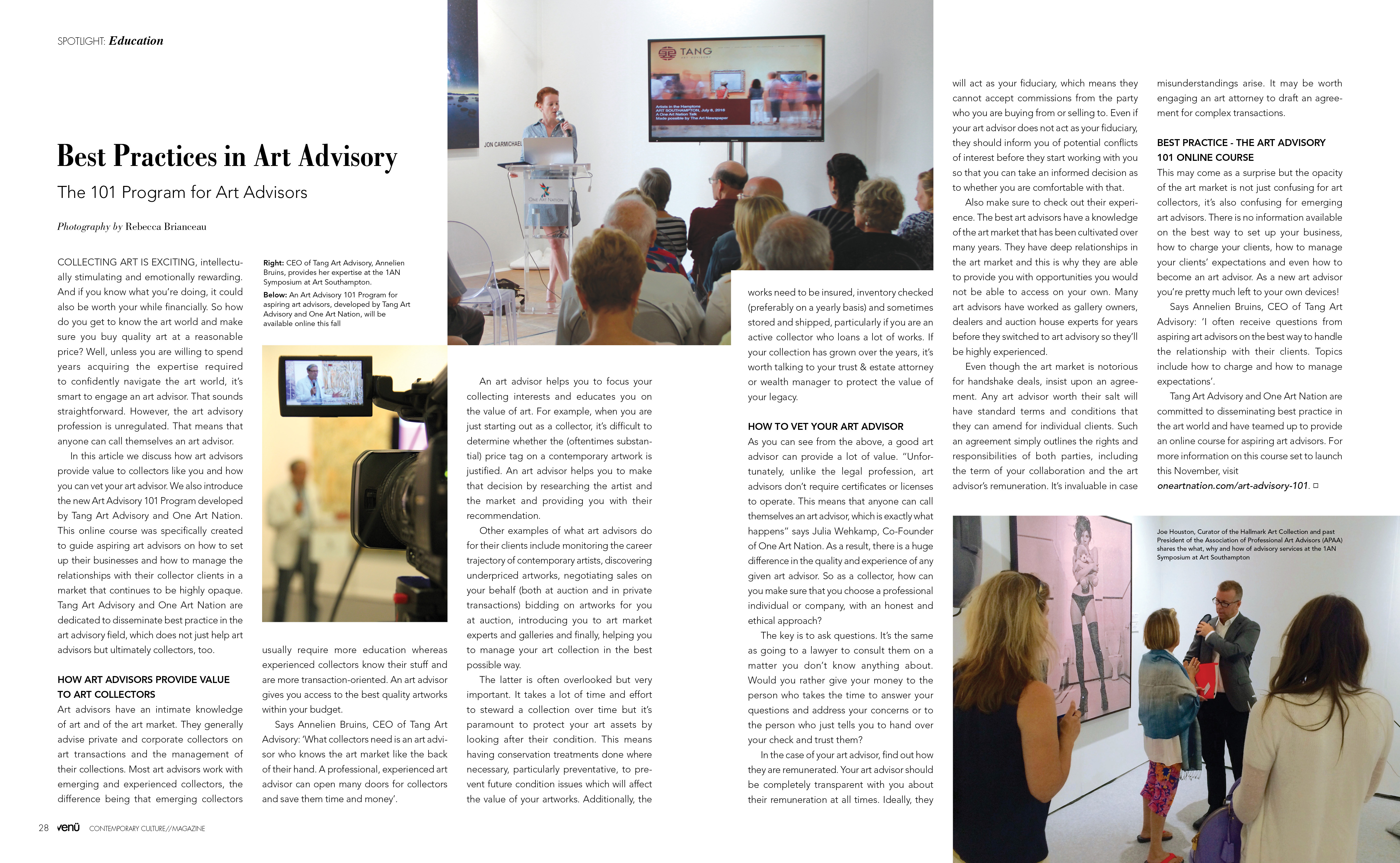
To help aspiring advisors with all of this and more, 1AN offers the Art Advisory 101 Program, created to guide aspiring art advisors on how to navigate the art world, set up a successful art advisory business and follow best practice. Already a practicing advisor? Then Art Advisory 201 will benefit those of you wanting to gain a deeper, more technical understanding of what it takes to run a successful art advisory firm.
One of the most valuable aspects of a curated museum exhibition is the accurate and logical perspective a visitor can gain from observing both the artwork on display and its comparison to similar categories and painterly styles in art. In fact, from an educational point of view, the old saying “the more you look the more you learn” certainly remains appropriate, particularly in the world of art. If you want to eventually secure your own opinion about contemporary art and receive an art appreciation education on your own, it is necessary to be an assertive private investigator of sorts, making evaluations, judgments and finally an informed analysis of overall quality and originality. Scholarly essays most often generate the most truthful and intellectual outlook with analytical reporting and assessments from art history that seem appropriate. The most satisfying reviews of an exhibition need to offer the reader a clear stance on what the artwork is all about, a detailed description of mark-making and the evolution of the artist’s technique and a factfinding report on how their work fits into the historical timeline and how it compares with similar art forms. Because of the concentrated grouping of works in a museum show, it is by far more educational and valuable (and private) to evaluate paintings there with a common denominator of methods and attributes than to sift through an entire art fair for hours, discovering hundreds of artists in a variety of mediums both new and old.
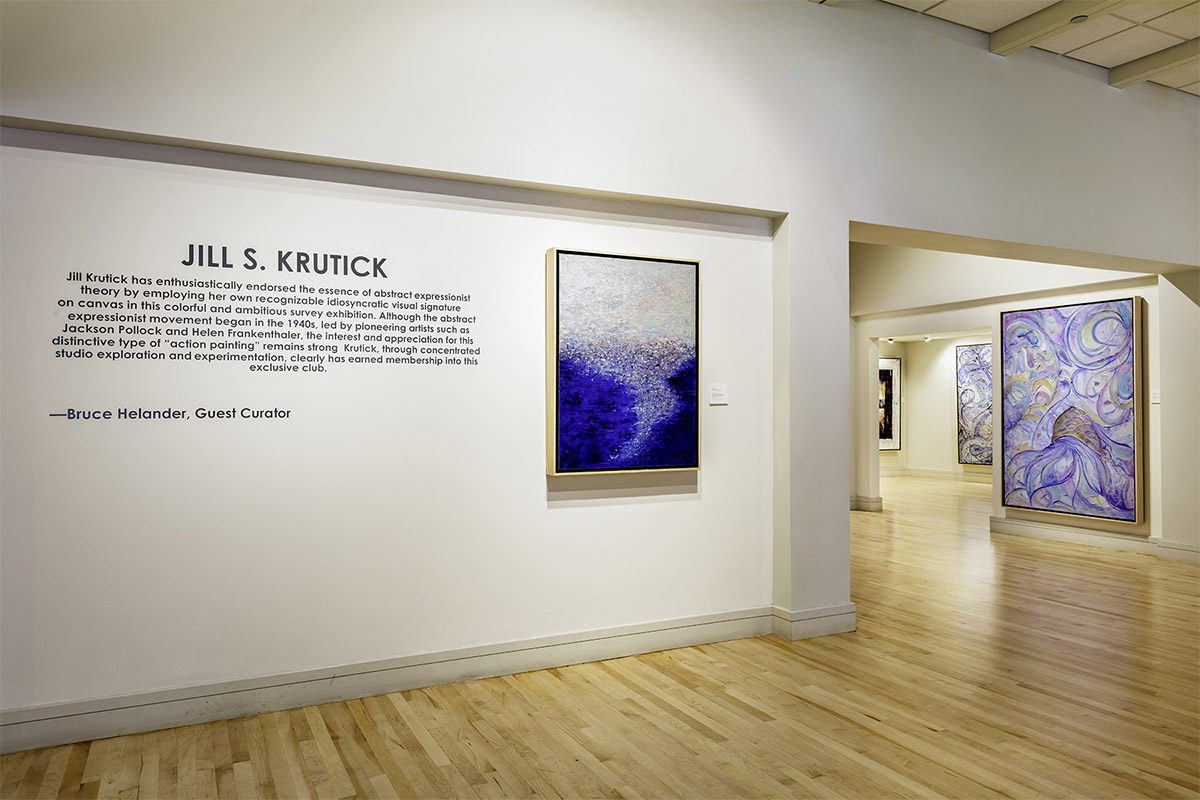
The current exhibition by Jill Krutick at the Coral Springs Museum of Art not only is a glorious show to visit in South Florida, but it affords a visitor with a close-up and personal display of an individual’s superb practices and recognizable style. Through this magical display we can perceive a lot about how creative pioneers set the developmental stage for other talents to follow. It’s been said that America has two distinctive forms of culture that we can call entirely our own. Abstract expressionism and American jazz (abstracted music), which were permanently, completely and uniquely stamped “Made in the USA!” These still retain the value of inventiveness and a revolutionary spirit but with a fresher approach and the thrill of something new to ponder. By the excellent reception Krutick has received to date and the sheer natural abstract beauty of her large-scale non-narrative “action” canvases, history not only is on her side, encouraging and persuasive, but she actually has added another exciting, singular chapter and dimension to important advances in contemporary abstract expressionist-infused color field painting. This certainly is a valuable opportunity for anyone who wants to learn more about competent professional picture-making on a grand and provocative measure.
One of the most anticipated museum exhibitions of the season in South Florida, a dazzling display of works by the New York and Miami based artist Jill Krutick, recently opened at the Coral Springs Museum of Art.
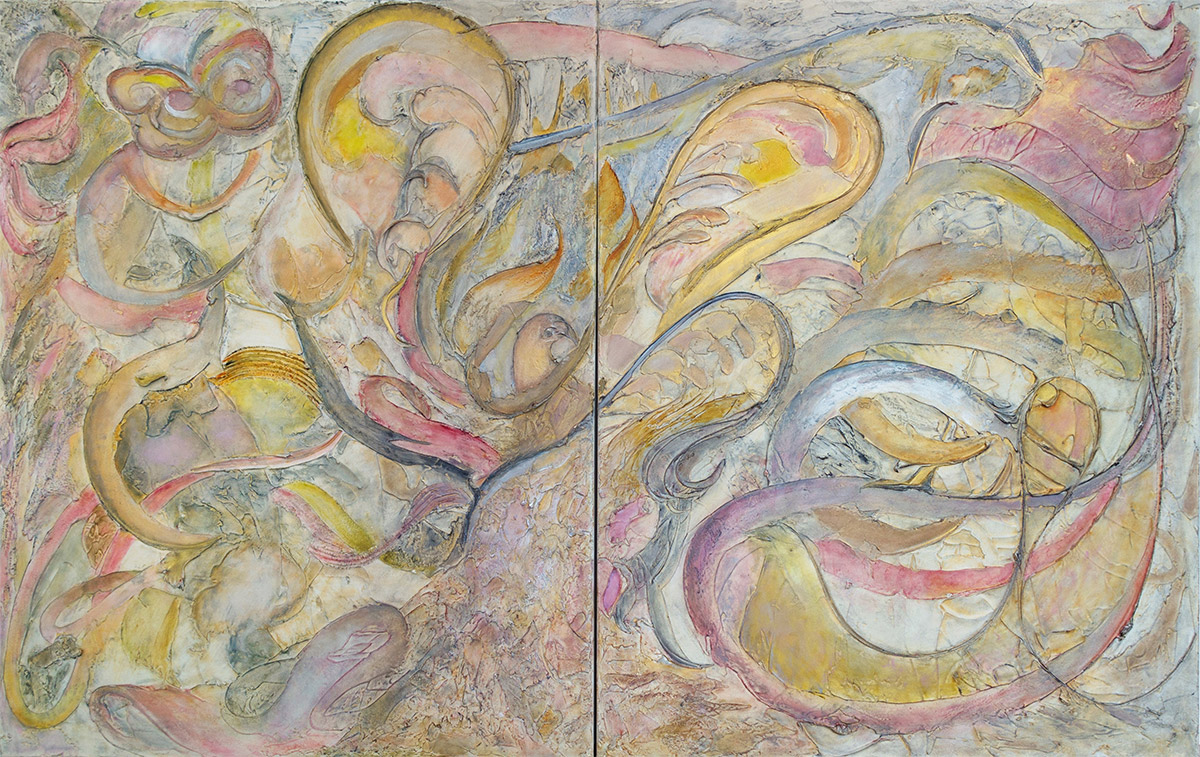
Within the impressive grand space of the museum’s main gallery, Krutick has put together an engaging and provocative show that demonstrates a professional commitment to exploring post-abstract expressionist theory. Large-scale canvases confront the viewer with a recognizable common denominator of an energetic visual spirit often punctuated with twisting swirls of paint accented with delightful shades of pastel colored backgrounds, some of which are supported with a foundation of molding paste, gloss and enamel that is gradually built up, resulting in brilliant spatial illusions and a composition that is free-flowing and pleasing to the eye.
Jill Krutick enthusiastically has traveled this eminent and original expressionist avenue through a keen perspective on art through the past and a devotion to securing her own distinctive voice that is evident in this compelling exhibition. Krutick certainly has assimilated a variety of standard elements important to the abstract expressionist/color field movement characterized by her signature gestural brushstrokes and spirited mark-making with a confident measure of necessary intellectual ingenuity and spontaneity. She has managed through vigorous investigation and diligent studio work to formulate her own identifiable take on the on the recognized components of abstract expressionism.
Krutick became interested in art at an early age, and like Hans Hofmann, she also studied piano, which seems to have implanted a subtle subconscious ambulatory rhythm in many of her works. A good example of the inherent illusionistic movement in her paintings is Moonstone, a rich impasto on canvas in which homemade textured surfaces contribute to an easy breezy composition of delightful repeat swirls and tunnel-like circular shapes. These disparate gestures could almost serve as a meteorologist’s aerial map of the Atlantic, forecasting the chance of a brewing high pressure system that could develop into a powerful storm of rich blues built on a foundation of white-capped waves and circular currents. Krutick reiterates this painterly mystical ocean voyage in an appropriately titled work called The Journey, which is a carefully crafted configuration of ribbon like-forms that are spiraling in a condensed perimeter as if looking for an opportunity to escape. The Journey is starkly spare in textured shades of azure, making it a task artistically but also a particularly powerful piece despite its lack of colors.
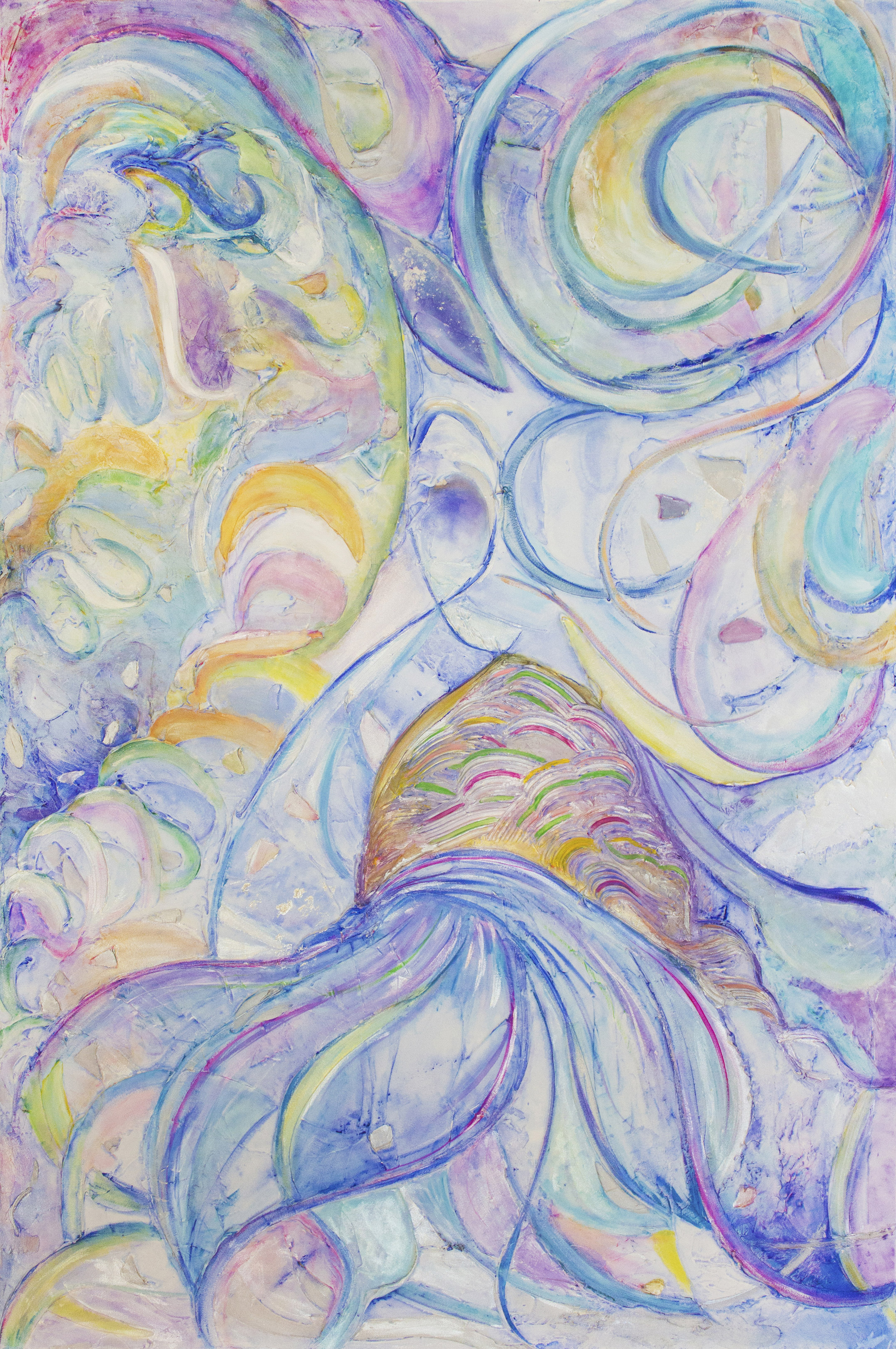
Jill Krutick, Rainbow Fish, 2018, Acrylic on canvas, 72 x 48 in.
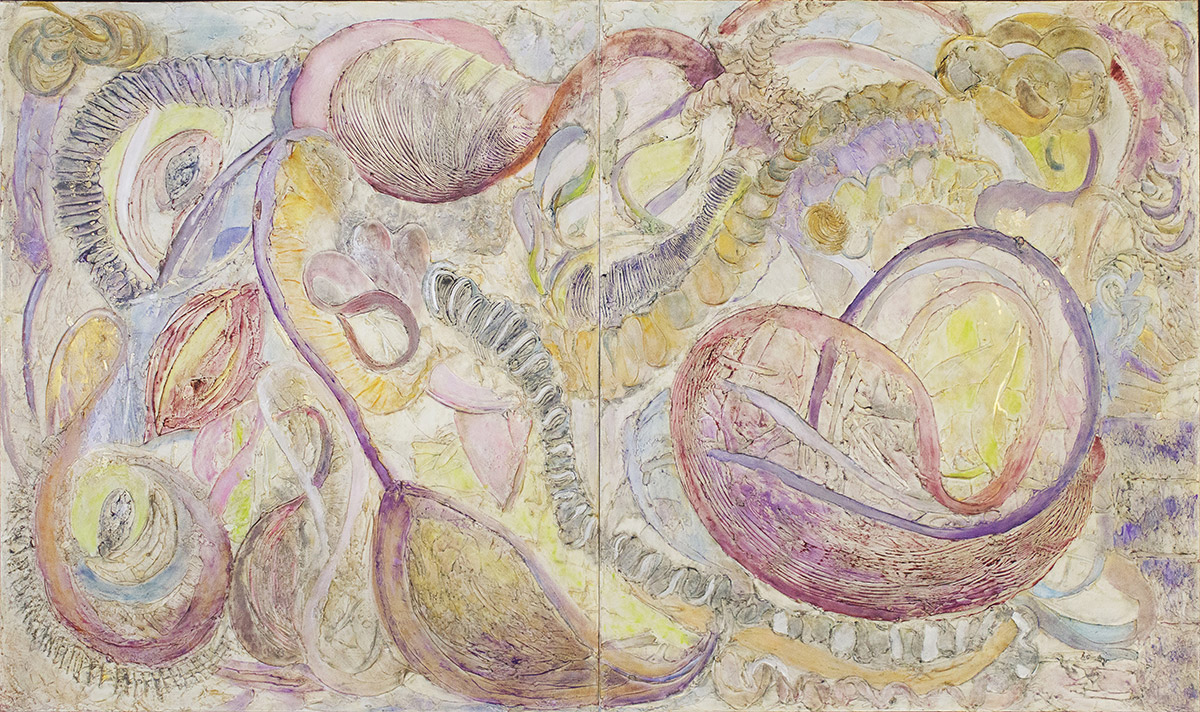
Jill Krutick, Dance of the Caterpillars, 2018, Acrylic on canvas, 72×120 in.
Jill Krutick, Phoenix, 2018, Acrylic on canvas, 60 x 96 in.
Krutick says that “Painting is a highly emotive form of self-expression, providing an outlet to embrace my spirit, untangle my thoughts, and connect with others. Upon finding the balance of shape, movement, light and hue, I unlock new discoveries about the world around me; fresh insights about myself; and embrace viewers willing to embark on a journey of self-reflection and critical thinking.” She continues to describe her methods: “I select a few colors and a base texture, then use a layering technique to reveal the topography of the piece. By this process, I capture the movement by blending and building color in order to create depth or subtle touches on the surface. I am spontaneous when I paint; the element of chance stimulates my creativity and allows me to interpret my world through a tactile experience.”
Judging by this ambitious show, Jill Krutick has mastered the essence of lyrical abstraction when it comes to evaluating the difference between a moderately acceptable picture and a truly engaging and exciting composition that’s full of rhythm and blues. Of course, not all paintings take on the tints of the ocean and many of these new works seem to take a cue from the earth’s surface with deep color combinations with tones of gold, tan, ochre and burnt umber, all accented with a purely harmonic blend of natural organic hues. In a work titled Rainbow Fish, Krutick demonstrates her ability to merge standard elements of land, sea and air in an uplifting festival with a literal rainbow that delightfully spans the color wheel spectrum in all its glory. In two particularly vibrant works titled Phoenix and Dance of the Caterpillars, she has employed a similar palette (if not the same mixing board) to produce a bountiful harvest of floating forms and interconnecting lines that could be attached to some rare plant life from another world. Although most of the works have no narrative components, both of these suggest a covert title. In The Journey, one might perceive the frozen aftermath of an Olympic skater’s icy track, swirling in a curvy poetic motion that stays visually quite comfortably within the parameters of the skating rink. For Krutick, an obviously talented and serious artist, painting is a conscientious occupation showing indelible signs of significant pictorial achievement that also is built on the intriguing history of women artists who took on the bold quest to make innovative paintings on an unequal playing field while celebrating their independence and permanently engraving their own personality and signature style for all of us to interpret and enjoy. Jill Krutick clearly has become a member of this exclusive club.
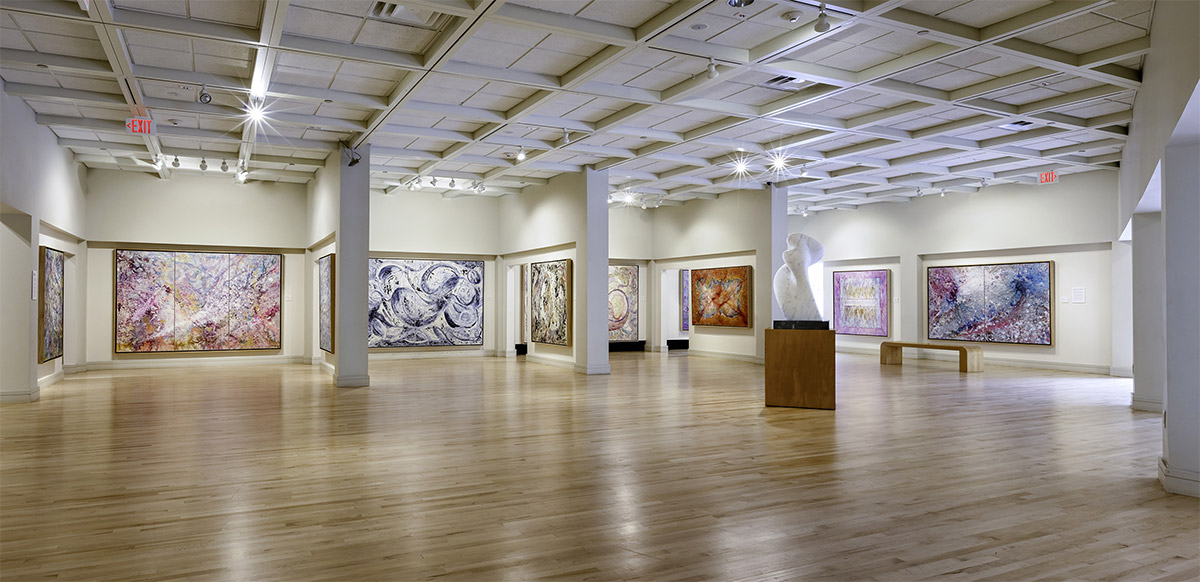
Installation, “Jill Krutick: Lyrical Abstraction,” solo exhibition at the Coral Springs Museum of Art, Coral Springs, Florida. Through May 18, 2019. Credit: Sargent Photography.
Installation, “Jill Krutick: Lyrical Abstraction,” solo exhibition at the Coral Springs Museum of Art, Coral Springs, Florida. Through May 18, 2019. Credit: Sargent Photography.
Installation, “Jill Krutick: Lyrical Abstraction,” solo exhibition at the Coral Springs Museum of Art, Coral Springs, Florida. Through May 18, 2019. Credit: Sargent Photography.
Drew Watson, Vice President, Art Services Specialist at U.S. Trust, Bank of America and course instructor of our Art Wealth Management Program shares the experience he gained from Christie’s, how collectors are making art part of their broader wealth strategy and how art loans can generate liquidity.
Tell us how your professional life first intersected at art and finance?
My first experience working at the intersection of art and finance was at Christie’s in New York. One of my responsibilities as a business manager for five different art sale departments was running a P&L and structuring consignment deal terms for live auction, private sales, and online sales. Auction houses employ a variety of deal structures to land consignments. These include enhanced hammers, guarantees, and auction advances, the latter effectively functioning as bridge loans to provide liquidity to the consignor leading up to a sale.
In your opinion, is art an investment asset? A financial asset? Both? Please explain.
Traditionally, collectors have acquired art primarily for aesthetic reasons. The aesthetic enjoyment is still the leading motivator for most collectors, but many are now also seeking a financial return. Our view is that art is a capital asset that can represent an important portion of a client’s balance sheet. Collectors are increasingly considering art as part of their broader wealth strategy by factoring it into their charitable giving, accessing capital by borrowing against their art, and using art to minimize estate taxes and capital gains taxes.
How can borrowing against their art collections be beneficial for art collectors and investors?
An art loan can allow collectors to unlock capital from an illiquid asset while still maintaining both ownership and possession of the art. We see many different strategic applications of art loans as a source of liquidity. Some recent drivers have been hedge fund and private equity principals unlocking capital from their collections as part of an arbitrage strategy. We have also seen developers using an art loan as a real estate development line, and business owners using an art loan as a working capital line for their business. An art loan can also generate liquidity needed to pay estate taxes, or even help accelerate an acquisition strategy to buy more art.
Find out more about Art Finance Solutions in Wealth Management and Estate Planning with Drew Watson. Enroll in our Art Wealth Management Program today!
For more information, contact U.S. Trust art services group at 646.855.1107, or visit ustrust.com/art. Neither U.S. Trust nor any of its affiliates or advisors provide legal, tax or accounting advice. You should consult your legal and/or tax advisors before making any financial decisions. Credit and collateral subject to approval. Terms and conditions apply. Programs, rates, terms and conditions subject to change without notice. U.S. Trust operates through Bank of America, N.A., and other subsidiaries of Bank of America Corporation. Bank of America, N.A. and U.S. Trust Company of Delaware (collectively the “Bank”) do not serve in a fiduciary capacity with respect to all products or services. Fiduciary standards or fiduciary duties do not apply, for example, when the Bank is offering or providing credit solutions, banking, custody or brokerage products/services or referrals to other affiliates of the Bank.
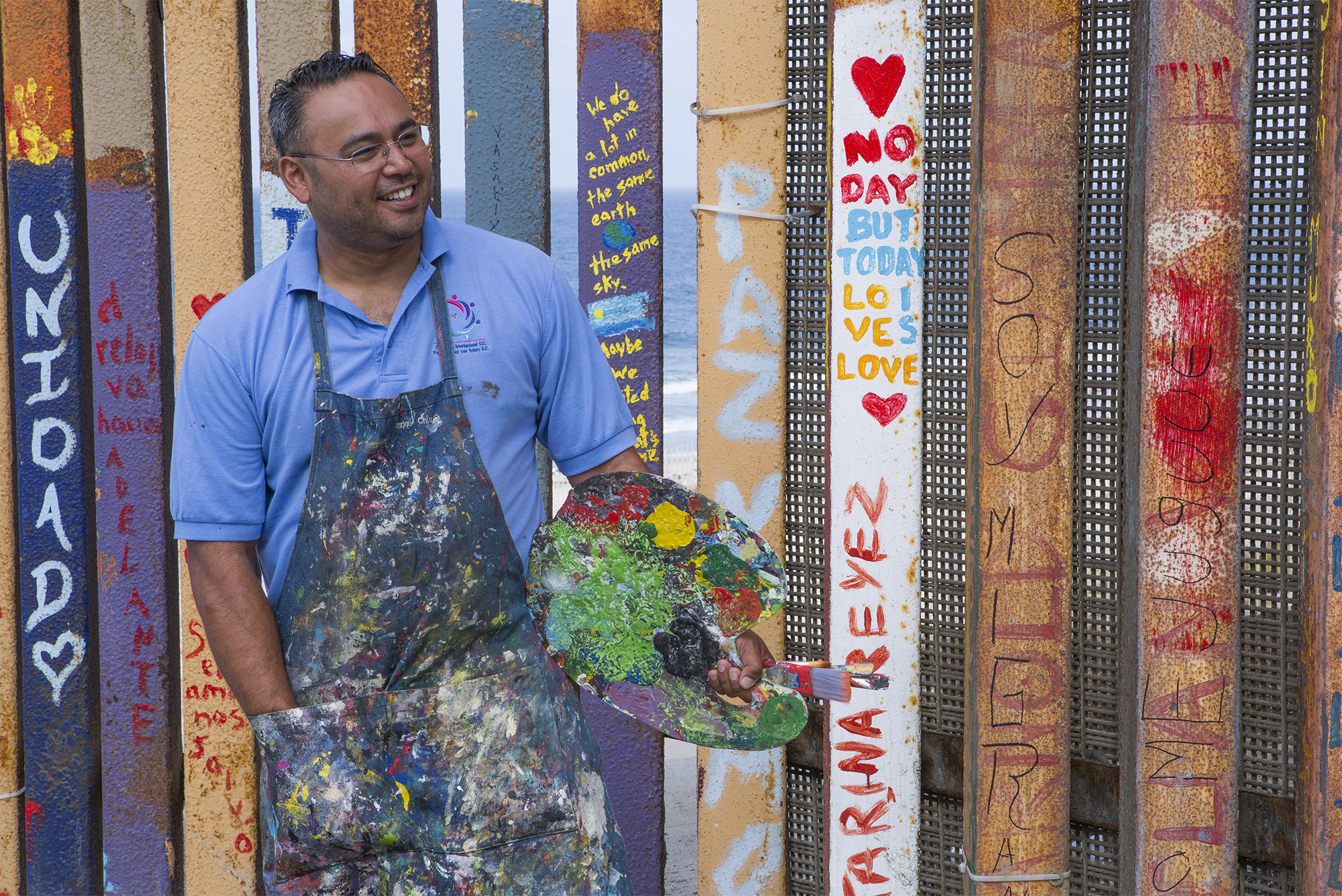
This month, our featured member is well versed on both sides, as an artist AND a collector! Please meet Enrique Chiu who lives between San Diego and Tijuana. As an artist, his work has been exhibited in galleries and museums across Mexico, Europe, the Middle East and North and South America. He is the creator behind the “Mural of the Brotherhood” at the USA / MX border wall. But today, we learn more about Enrique-the-Collector!
Have you purchased art before and if so, tell us about the first piece you acquired?
Yes, I generally buy at auctions. I have about 200 works by both well-known and emerging artists. I purchased my first piece from a gallery in Long Beach, California in 2003 by Raul Anguiano – a lithograph signed on both sides from 1974.
What work of art do you wish you owned and why?
I would like to own a Basquiat, a van Gogh, a Modigliani, a Botero, a Picasso…. Something to continue my art collection and share it with generations to come.
We see you are a fairly established artist as well, so you are really on both ends of the story! How do you describe your art to people who’ve never seen it before?
I have been an artist for 20 years, and I have found a market in the United States, Mexico and throughout Europe. Finding collectors is more difficult when they do not know you, but my artistic work addresses the most relevant topics in life and history, as well as social matters and the phenomena that are experienced daily in our world, in a colorful, positive, surreal and abstract way that anyone could enjoy.
How does being an artist influence your collecting style?
As a collector, I think it is important to know the story of the artist and their work in order to understand the value of the piece. Knowing the history and trajectory of artist makes a purchase easier.
With so many inspirational members, 1AN has decided to feature one per month to share their thoughts on and experiences with art. One common thread we’ve found so far… every one of them loves art! That’s why we all get along! We start this feature off with Toronto-based criminal lawyer and art collector, Daniel Rechtshaffen, who shares why he loves art, how he got his first piece, and offers up a tip for emerging collectors.
How did you come to love art?
Back in 2002, a friend from law school introduced me to a photographer friend of hers and we hit it off immediately. That friend was my Art Mentor when I was first getting into this scene. Through her I met more and more artists and that amplified my interest in contemporary art. Living in that world made me fall in love with the artists as much as their art. I really prefer to buy work from people I love.
What was the first piece you ever acquired and how did you go about it?
It was a Joshua Jensen Nagle photo shot on expired Polaroid film. Josh and I met at the Toronto Outdoor Art Fair and I bought the piece out of his studio.
Do you have any advice for emerging collectors out there?
Buy what you love. If a piece of art appreciates in value then that’s a bonus, but you have to live with it every day. Make sure that investment hanging on your wall stirs something deep in your guts.
Steven Schindler of Schindler Cohen & Hochman LLP and course instructor of our Art Wealth Management Program discusses which laws protect art collectors and investors, what to do if you acquire a fake and three must have protections in a buy sell agreement.
How did you get into art law?
Although I have always had an interest in art, I never thought I would be an “art lawyer.” I spent the first part of my career as a business litigator, representing clients in complex commercial disputes. When I was asked fifteen years ago to represent a large art gallery in a dispute over the ownership of a work by the Italian baroque painter, Guido Reni, it seemed like a natural fit. That engagement then led to others, appointments teaching “art law” at Sotheby’s Institute of Art and NYU, the creation of Schindler Cohen & Hochman’s Art Law Group, and the launch last year of The Art Law Podcast.
What are the main legal risks that art collectors and investors need to be aware of before getting into the art market? How can a collector or investor do due diligence to make sure they don’t buy a problem work?
The two main areas of risk relate to ownership of the work and authorship of the work. Fine art is generally only as valuable as it is authentic. Meaning the true identity of the artist is essential to its value. It is very difficult to be 100% sure you are buying an authentic work of art unless the artist is still alive. But with a deceased artist there are many things a collector/investor can still do. The first is to ask for a full provenance history of the work and make sure that the provenance makes sense.
The second would be to ask an expert to inspect the art and comment on its authenticity. This can be costly and many experts are hesitant to offer these opinions formally, but may do so informally. The most important and easiest thing a collector/investor can do is to work with a reputable art dealer that has a track record for honest dealing and who will be around and motivated to assist if something goes wrong down the line, even if they are not legally obligated to do so.
As for the ownership of the work, it is important to make sure the work of art is being sold free and clear of all claims and liens by the true owner of the work. A buyer can run a UCC search to see what, if any, liens exist on the work and can also get representations and warranties as part of any sale documentation attesting to clear title.
Are the legal risks different for different types of transactions (e.g. buying and selling at auction, through a dealer or privately)?
Yes. In general, buying from an auction house is safer because auction houses are regulated and have the staff and incentive to do a lot of critical due diligence on works of art prior to sale. They will also take work back within 5 years of sale and provide a refund if the work is found to be inauthentic.
In a private sale, the type and depth of due diligence done on a work prior to sale will vary by dealer or seller. It may be challenging to find the dealer or seller down to road or recover from them if they disappear or go out of business, or simply lack the liquidity to refund the payment. Unlike an auction sale contract, the law provides a buyer a right of rescission within four years if the work if found to be inauthentic.
Learn more about Legal Aspects of Art Transactions and Risk Factors in Art. Enroll in our online Art Wealth Management Program today!
Note: This interview is not intended to be a source of legal advice for any purpose. Always seek the legal advice of competent counsel in the relevant jurisdiction.
Katherine Wilson-Milne of Schindler Cohen & Hochman LLP and course instructor of our Art Wealth Management Program discusses which laws protect art collectors and investors, what to do if you acquire a fake and three must have items in a buy sell agreement.
Which laws protect art collectors and art investors?
The Uniform Commercial Code, which regulates the sale and transfer of goods, and common law contract, fraud, mutual mistake, and negligence doctrines are some of the legal protections.
State laws such as the New York Cultural Affairs Law may also provide added protection for collectors and investors when purchasing works.
By far the easiest way to be protected is to have a sale contract with representations and warranties from the seller and to have done due diligence prior to acquiring the work.
What recourse does a collector have if they have acquired a fake, or overpaid for an artwork?
If a collector acquires a fake, she can sue the dealer for breach of the warranty of authenticity under the Uniform Commercial Code or the New York Art and Cultural Affairs law. Because the 4 year statute of limitations begins to run at the time of the sale, and the discovery of the fake often occurs years later, that remedy is not always available.
If there were representations made under a purchase agreement, the collector can sue for breach of that agreement, where the statute of limitations is often longer.
If the collector and dealer were both mistaken about the work’s attribution, the collector can sue for “mutual mistake,” and ask a court to rescind the purchase agreement, requiring the collector to return the work and the dealer to refund the purchase price.
If the collector has reason to believe that the dealer knew he was selling a fake, the collector may sue for fraud, among other claims.
We understand that every art transaction is different and that it’s difficult to generalize, but what are the 3 must have items that you would recommend collectors and investors include in a buy or sell agreement?
There are, of course, more than three important items in any agreement to purchase art, but the ‘must have’ items would include:
A representation and warranty by the seller that he has clear title to the work and that the work is free of any liens or encumbrances;
A representation and warranty that the work is “authentic”; and
An agreement by the seller to indemnify the purchaser for any claims made by a third party relating to any of the seller’s representations and warranties, but particularly the two listed above.
Learn more about Legal Aspects of Art Transactions and Risk Factors in Art. Enroll in our online Art Wealth Management Program today!
Note: This interview is not intended to be a source of legal advice for any purpose. Always seek the legal advice of competent counsel in the relevant jurisdiction.
The program is an introduction to the art market from an investment perspective
The Certified Financial Planner Board of Standards will provide three hours of continuing education credit that counts toward CFP certification for a new online art wealth management course.
The program, created by New York-based Tang Art Advisory and online art community One Art Nation, is an introductory course on the art market from an investment perspective. It is the only active continuing education program that focuses solely on art wealth management, according to Mary Kay Svedberg, director of education at the CFP Board.
“There’s a lot of misconception on art and how different it is from the financial market, so we wanted to make a program for financial managers to give them an opportunity to learn what the art market really is,” said Annelien Bruins, chief executive officer of Tang Art Advisory, who is also acting as the lead for the new program.
It’s a market that has grown substantially. Sales in the global art market reached $63.7 billion in 2017, up 12% from the previous year, according to a 2018 study from Art Basel and UBS. The U.S. made up the largest share, accounting for 42% of the sales by value….Read more
Mary Buschman, President of ARIS Title Insurance Corporation and course instructor of our Art Wealth Management Program explains what title risk in art transactions mean, the four categories of risk and how art title insurance works.
Can you explain what title risk in art transactions means and why it is so much more complex than for example, in real estate?
The art market title risk crosses all genres and periods and impacts all industry participants. Buyers and their advisors routinely cannot find out who owns the art or collectible offered for sale. Historically, the art market has always considered this information to be confidential, and the true owner is generally not the art dealer or gallery offering the work for sale. Because buyers often do not know who owns the work, buyers cannot begin to manage the ownership risks. A licensed art title insurance company has the unique expertise to underwrite and assume legal title risks for art and collectibles.
Risks generally fall into four categories:
Contemporary and Historical Theft
Import and Export Defects
Liens and Encumbrances
Illegal or Unauthorized Sales
In the real estate market, legal title must be transferred by a deed and recorded at the County Recorders or Recorder of Deeds office where the real estate is located. Abstracts of title are created which include the condensed history of the title for a particular parcel of land, including a summary of the original grant, all subsequent conveyances, encumbrances affecting the property and a certification by the abstractor that the history is complete and accurate. In the United States, the abstract of title furnishes the raw data for the preparation of a policy of title insurance.
Are there categories in the art market that are more susceptible to title risk than others (i.e. Contemporary vs. Old Masters)?
The art market affects all periods of the art and collectibles market in various ways. Objects created prior to the end of WWII can be affected by all of the risks noted above. The Post-War market can be affected by all risks except historical theft. The historical theft risk not only includes WWI and WWII but also Russian Revolution, African colonization and Spanish colonization just to name a few.
Financial liens and encumbrances often impair clear legal title to contemporary and primary-market fine art. Common scenarios include: a creditor claiming a security interest in the art because the seller used the art to secure financing but did not pay back their debt to the lender; the seller failed to disclose a right-of-first-refusal clause in the bill of sale between the first dealer and the first buyer, either intentionally or because the seller did not know that the clause existed; or, the seller entrusted the work of art to a dealer or gallery for sale and the dealer sold the consigned artwork without paying the seller the proceeds.
How does art title insurance work?
The ARIS Art Title Insurance policy has a one-time premium for lifetime of ownership until the insured object is sold or donated. The policy automatically extends to heirs-at-law. Coverage includes indemnity plus defense costs. That means that if a party came forward with a claim of ownership on the insured object, the insured would be covered for all legal defense costs. If the claimant won, then the insured would be paid the full value of the limit of liability. So, for example, if the insured lost in court and was required to relinquish their $1 million art object, ARIS would pay out their $1 million. The insured’s legal costs and full investment in their artwork are covered.
The ARIS Art Title Insurance policy not only covers fine art but also rare books and manuscripts; rare stringed instruments; music, sports and movie memorabilia; museum quality jewellery; ancient objects and vintage automobiles.
Learn more about Legal Aspects of Art Transactions and Risk Factors in Art. Enroll in our online Art Wealth Management Program today!
Art Wealth Management, explains how art appraising and advising overlap, the difference between art appraisals and auction estimates and the importance of USPAP compliant appraisals.
What lead you to become a certified art appraiser as well as an art advisor? Do the two areas of expertise overlap?
Whenever I help a client buy or sell a work of art it is essential for me to have a thorough and accurate understanding of an object’s value in order to a conduct a successful transaction, evaluation or loan so indeed art appraising and art advising overlap to a great degree! As such, early on in my career I became a qualified professional appraiser and certified member of the Appraisers Association of America, a major respected appraisal accrediting organization in the US.
How is an art appraisal different from an auction estimate?
An art appraisal is a legal document that offers an opinion of value of an artwork that can be relied on by third parties such as attorneys and the IRS. It also has enough credibility to stand on its own merits. A properly conducted appraisal requires extensive research, analysis, scholarly documentation and calculation while following specific guidelines in compliance with the Uniform Standards of Professional Appraisers Practice (USPAP). An experienced appraiser must be able to determine which type of appraisal and which kind of value is appropriate to apply and they are able to defend their value conclusion through an extensively written document.
In contrast, auction estimates are not intended to be relied on by third parties nor are they meant to be an accurate reflection of an object’s value. However, they do give prospective bidders a better context to help them understand what the current market for that object is. Estimates are based on comparables from which a median range is taken where the auction house believes the current market exists. Estimates serve as an effective tool for auction houses to entice potential buyers by either placing intentionally low estimates to attract more bidders or intentionally elevated estimates to give the perception of high quality in an effort to maximize the potential hammer price.
In which cases does an appraisal need to be USPAP compliant and why?
If you need your appraisal to withstand the rigors of the law, IRS scrutiny or to be mostly reliable, a well researched and well written report that is USPAP compliant would be necessary. However, many appraisers are requested to provide expedited opinions of value that may not meet the minimum standards of a formal appraisal (ie. TV shows, newspapers, inquiries to help with an internal review or pre-sale) so the Appraisers Assoc. of America has now allowed for sub-services to be conducted where appraisers can administer Professional Opinions of Value (aka Value Opinions) without being subject to violation of the AAA Code of Ethics.
Learn more about what factors influence the art market and the different types of appraisals. Enroll in our online Art Wealth Management program today!
Jacqueline Towers-Perkins, Specialist, Post-War & Contemporary Art at BONHAMS and course instructor for Art Wealth Management explains the idiosyncrasies of this fragmented market, how to go about collecting art and her excitement for contemporary works.
Tell us how you came to be an art expert and why you love the contemporary art market.
I have always been drawn to Contemporary Art because it is so dynamic and progressive, which keeps both my job and the field I work in hugely interesting. Not only are the artists and works they create exciting, investigative and challenging, but the market itself – the key players, prices achieved, the fast pace and constant change of patterns and trends – remains fascinating.
If a collector wanted to invest in contemporary art, how would you recommend to get started?
Firstly, I would advise someone to discover what it is that they like, what they are interested in and what they have a drive for collecting or investing in. A passion for an area of the market will endure any transitory trends or patterns. Once they have identified an area, I would recommend that they educate themselves. Visit auctions, art fairs and galleries to see and understand how the market works and what themes are changing and emerging each season. Lastly, create and build relationships with industry professionals in order to learn from them.
What would you consider the main benefit of investing in art? And the biggest disadvantage?
The main benefit is the pleasure and privilege of being able to enjoy a work of art while it appreciates. It is wonderful to have the opportunity to look at, enjoy, live with and learn from an individual work or a larger collection over time. If you have acquired a work of art because you love it, then it is a huge bonus if it appreciates in value during that period. No other investment provides such rich intellectual or physiological dividends. Arguably however, this lack of monetary dividends and illiquidity traditionally requires art investment to be seen as a long term, which can be a challenge and a disadvantage to those seeking short-term results.
What is the main difference between the art market and the financial markets?
The greatest different I have found between the markets is the highly specialized expertise and knowledge required to invest in art and navigate the art industry. Unlike the financial markets, which are open to all and are required to be transparent, the art market, and particularly private sales from galleries, can be notoriously opaque. Because of this, a strong knowledge and experience of how the market works is essential.
Learn more about how the art market differs from the financial markets. Enroll in our online Art Wealth Management program today!
One of the most talked about exhibitions in Palm Beach County this season was “Drawings for Sculpture,” produced by artist Hubert Phipps for the Gallery of the Center for Creative Education set in the historic neighborhood district of Northwood in West Palm Beach.
If you were not prepared fully in advance, you likely would be pleasantly surprised upon entering the main gallery to be confronted with one of the most bold and inventive black and white charcoal drawings that I have ever seen. This huge work on paper certainly lives up to its title Mystique, as it definitely is enigmatic and oddly spiritual at the same moment, and for many viewers, mesmerizing. This sensitive composition fits perfectly within the drawing parameters of Phipps’ show, as most of the studies could be compared to an architect’s blueprints where the sketches are eventually transferred to clay and then finally cast into bronze sculpture. So, it was quite provocative to view a totally conceptual picture, drawn and then erased, re-drawn and then “polished” over again by the artist (often with his feet and hands!), with other edges sharpened or toned down and some areas brightened and elongated, and yet this magnificent charcoal composition retained its integrity and mystery. This adds significantly to the visual drama of this handsome conceptual piece, which could almost be mistaken for a surrealist smoke signal rising from an Egyptian incense stick.
The handsome gallery, a former roller rink built in the 1950s, still retains some of its original wood flooring, and the tall exposed ceilings and iron support beams introduce yet another dimension to what is considered the best show of the season. Visitors were welcomed into the first exhibition space, which displayed Mystique next to a black baby grand piano that was a perfect match of form and function. A second “mystical” drawing, titled Dreamscape, was placed above the piano, which curiously built up an exciting visual energy and, forgive the pun, a sounding board where all the objects in the room seemed to work together in harmony.
Hubert Phipps, Mystique, 2018, Pigment on paper, 44 x 92 in. (111.76 x 233.68 cm)
Hubert Phipps, Dreamscape, 2017, Charcoal on paper, 20 x 43 in. (50.8 x 109.22 cm)
Thousands of years ago, there is evidence of primitive humankind developing an affection for sculpted objects, oftentimes crafted out of wet clay or mud in all sorts of shapes, some of which were decorative and others simply utilitarian, such as a vessel for liquid or grain or even an earthen square brick that when multiplied would assist in building shelter. Later, as craft became more sophisticated and artists began sculpting forms in stone, it was more efficient to begin this long development process by carefully sketching out the object first, whether it be human or animal or organic, long before the actual construction of a sculpture began. Its important to note that legendary artists like Michelangelo would judiciously outline a sketch on a block grid that would serve as a blueprint for a much larger and ambitious final result. A good example of his early exploratory drawings is the figure studies for David, the 17-foot carved white Carrara marble statue still standing in Florence. The idea of beginning a project of this complexity without the initial studies, instead starting from scratch with a hammer and chisel, would be sheer madness.
So, the concept of creating drawings for sculpture was an accepted practice that became particularly popular during the Renaissance. The sketchbooks of Leonardo da Vinci are quite remarkable, as they not only included memorable charcoal studies for portraits that would be completed in the future, but in this case, served as a valuable collection of sketches for da Vinci’s inventions, from the concept of a helicopter (Hubert is a certified helicopter pilot) to a submarine. “If you could draw it, then you could make it,” became a kind of mantra for aspiring artists who wanted to breakout from conceptual drawing of objects to letting only the limits of their imagination guide them into prominence.
In what is considered a type of golden age of modern bronze sculptures, which began at the turn of the 19th century, many of the greatest artists of our time began to be recognized as historic innovators, whose influence continues to this day. Although the emphasis on Phipps’ exhibition certainly was on his preliminary and conceptual studies, the artist did present a modest overview of recent sculptural works, which offered an informative and satisfying comparison to the variety of drawings on display. Even on a moderate scale, the bronzes as shown in this exhibition were strong, interesting works that made a delightful comparative demonstration. These bronze sculptures of Phipps remind me of other works that have an arm’s length connection to many of the three-dimensional pieces on view at the CCE. Jacques Lipchitz, Figure, 1926 (MoMA), has its powerful beginnings in compelling sketches, as well as Henri Laurens’ La grande sirène 1945, a particularly delightful image of a bronze mermaid where you can sense the laborious test studies that shaped a masterpiece. I’m also reminded of Alberto Giacometti’s bronze Table (La table surréaliste), 1933 (Le Centre Pompidou), which relates to Phipps’ inventive stacked stainless steel pair of twin-like sculptures, Pieces of Six, 2015, and Pieces of Eight, 2016, that were among my favorites. For this handsome series, he decided to acquire bits and pieces of weathered metal geometric-shaped foundry fragments and then cast the pair of sculptural works into stainless steel, utilizing energy from the inventiveness of taking found objects and turning them into something expressive and convincing, which reminds me of Pablo Picasso’s bronze Woman with Baby Carriage, 1950 (Musée Picasso Paris), where the father of Cubism gathered pieces of junk metal that form a recognizable composition of a standing figure and a baby on wheels. Picasso loved discovering found objects, and like Hubert Phipps, could recognize at once the delicious possibilities at first glance. As a connective side story, Pablo and his girlfriend, Françoise Gilot, were known to wander around Paris pushing an empty baby carriage that he would fill with whatever promising bits and pieces of abandoned items that he responded to during their daily walks. Picasso’s most famous found object sculpture, Bull’s Head, 1942, was fashioned from a bicycle seat and handlebars that were highly abstract, but like Deborah Butterfield’s complicated found steel fabrications of life-size horses, these artists seem to create magical illusions with superior vision and ingenuity.
Hubert Phipps, (left) Pieces of Eight, 2015, Cast stainless steel, 14 x 29.5 x 8 in. (35.56 x 74.93 x 20.32 cm); (right) Pieces of Six, 2016, Cast stainless steel, 9 x 29.5 x 8 in. (22.86 x 74.93 x 20.32 cm)
Hubert Phipps, Quantum Universe, 2016, Charcoal on paper, 44 x 60 in. (111.76 x 152.4 cm)
Hubert Phipps, Waterworks, 2016, Cast bronze, 13 x 31 x10 in. (33.02 x 78.74 x 25.4 cm)
“Drawings for Sculpture” had its own magical presence at the Gallery of the Center for Creative Education, where Phipps mixed together the best of historic influences and the inherent grace of charcoal lines that seemed to develop a life of their own on the exhibition walls, exploding in character and individuality when placed next to the final evolution of drawings-into-three-dimensional objects.
Photography can be seen at any contemporary art fair these days. And it’s unlikely you’ll visit a well-regarded contemporary gallery that doesn’t include at least one photographer among their roster. Photography is also increasingly present at auctions as an important investment. Yet collecting photography remains daunting for many.
So we asked photography expert, Stephen Bulger about his tips for new collectors on navigating the market for photography.
Is collecting photography a good entry point to collecting art in general?
Many people find photography an easy entry point for a number of reasons, but for me in particular, two seem to stand out. Many of us have often failed in making good photographs, so it can be easier to recognize greatness in someone else’s photograph; most people are not as familiar with painting or sculpture. Also, photographs are usually created in more than one copy, so the work of an acclaimed photographer is often at a more affordable level than, say, a painter whose production is limited by the rarity of their medium.
What advice do you have for someone who is just starting to collect photography?
Know your budget. Before you begin, determine a maximum amount of money that you are willing to spend on a single photograph so when you see something you instinctively would like to own, and it falls in your budget, you can act fast. Too often people are worried about making a mistake, and they prolong their first purchase to the point that they grow sick of the exercise. People should remember their first purchase fondly and should understand that their first purchase is a major step forward.
What are the common misconceptions about collecting photography?
People are often confused about editions. Different artists incorporate different definitions of an edition, so it is good to ask what the edition actually means. Usually a photographer will not print the entire set of prints within an edition at the beginning, so quite often the prints realized are much lower in number than the edition indicates. Research has indicated that in the vast majority of cases, there are fewer than 5 prints extant of image, whether part of a closed edition or an open edition.
What role does photography play in the current art market?
It plays a vital role, especially because there are a number of popular photographs that were produced in multiples, so we are able to track prices attained for those images. Having the ability to compare “apples to apples” makes it easier to analyze market trends.
What are your five go-to tips for collecting photography?
Understand your goal: one photograph for a specific place; or building a collection over the next 5-10 years. This distinction between shopping and collecting should inform you about how much time and money to invest.
Choose a dealer who has a good amount of inventory of work you like within your budget.
Do your homework. Buy a book on the general history of photography. Ask a dealer you feel comfortable with to recommend some good books.
Look at as much original work as you can and compare. Buy with your eyes vs. your ears (i.e. don’t buy because of hype, trust your own taste).
If you begin to build a collection, realize that they are not fixed and will evolve as you evolve, so keep it intuitive.
January 24, 2018 was an intense, immersive and inspiring day: an existential linking of 13TH by Ava DuVernay, best known for her 2014 Best Picture nominated Martin Luther King drama Selma, at the New York State Bar Association Annual Meeting, and the opening of Derrick Adams’ Sanctuary at the Museum of Arts and Design. The State Bar Meeting is a good source for mandatory CLE credits and the morning session I attended was informative and useful, dealing with current issues in estate planning after the Tax Cuts and Jobs Act of 2017 and an insightful and humorous presentation on the wills of the rich and famous with the ten pitfalls to avoid. This entry, however, is not about advising artists on the estate planning and the preservation of a legacy. Read here for information on artists’ estates.
In the afternoon, I attended the Presidential Summit: Race, Slavery and Mass Incarceration, hosted by Sharon Stern Gerstman, President of the New York State Bar Association. The Summit featured 13TH, its title drawn from the 13th Amendment to the U.S. Constitution. DuVernay has stated her interest in the topic was visceral before intellectual: police officers were symbols of fear rather than safety.
Slide 1 from the New York State Bar Association Presidential Summit
When the 13th Amendment was ratified into law on December 6, 1865, it abolished slavery, with one key caveat: “except as a punishment for crime whereof the party shall have been duly convicted.” More than 150 years later, that exception has proven much more than a mere footnote to history. More African-American men are incarcerated, or on probation or parole, than were enslaved in 1850, and the United States, which accounts for 5% of the world’s population, counts nearly a quarter of the world’s incarcerated people. According to the American Bar Foundation, half of those imprisoned are parents. There are about 3 million children in the United States with an incarcerated parent or a parent who has recently been released.
According to the American Bar Association, “the reach of the criminal justice system extends even farther”. For every person in prison, America has two more people on parole, probation, or some related form of control. In actual numbers, that means that the U.S. has a total of more than 7 million people behind bars or subject to some kind of control that can land them behind bars.
Slide 2 from the New York State Bar Association Presidential Summit
Premised as a historical survey that maps the genetic link between slavery and today’s prison-industrial complex, 13TH begins with the depiction of black men as a threat to white women in the Birth of a Nation in 1917.
Juleyka Lantigua-Williams’ commentary in the Atlantic (Oct. 6, 2016) observed, “13th explodes the ‘mythology of black criminality’ as The New Yorker’s Jelani Cobb at one point in the film refers to the successive and successful measures undertaken by political authorities to disempower African Americans over the last three centuries. The academic and civil-rights advocate Michelle Alexander, author of the 2010 book The New Jim Crow: Mass Incarceration in the Age of Colorblindness, unpacks how the rhetorical war started by Richard Nixon and continued by Ronald Reagan escalated into a literal war, a ‘nearly genocidal’ one.
Other politicians in the film do not fare better: George H. W. Bush and his campaign attack against Michael Dukakis’s furlough program involving Willie Horton, Nixon’s “War on Crime”, Bill Clinton’s “Three Strikes and You’re Out” Crime Bill and Welfare Reform Initiatives, and Hillary Clinton’s response to the perception that the Clinton Administration was “soft on crime”, including her 1996 remark on “super predators”.
Throughout the film’s trajectory, a single word flashes in giant white letters on a black background: CRIMINAL. Is it a condemnation of past deeds or an accusation aimed at everyone who is complicit?
Shocked by the enormity of the problem, I sensed a collective sense of despair in the audience. Fortunately, the breadth of experience among the distinguished panel, comprised of Hon. Darcel D. Clark, Bronx County District Attorney and the first African American woman to hold that post in the U.S., Chanta Parker, Esq., The Innocence Project, New York, NY, Jeffery P. Robinson, Esq., American Civil Liberties Union, New York, NY, and moderated by Hilarie Bass, Esq., President, American Bar Association, provided a forthright exchange and a range of reactions to the issues of race, criminal justice and history raised by the film. Parker noted that African Americans in poor communities are presumed guilty until proven innocent, while Robinson stated “I’m angry because none of this is new…the criminal justice reforms being discussed, including bail and imprisonment for failure to pay fines and fees, will amount to so much ‘tinkering’ if the fundamental truth is not addressed about how today’s criminal justice system came to be and if we fail to acknowledge that we are a nation founded on the belief in white supremacy.”
The panel echoed the view of Ron Kammer, chair of the ABA Litigation Section, who stated in 2012: “As a nation, we have become addicted to incarceration. America didn’t behave this way. In the mid-1970’s, we made some disastrous choices that have taken a terrible toll. What we have come to think of as normal is anything but.”
Roy Lichtenstein’s “Masterpiece” (1962). Courtesy of the Estate of Roy Lichtenstein.
It is not surprising that Agnes Gund, the well known philanthropist, art collector and patron, former president of MoMA and current chair of MoMA PS1, was moved to action in January 2017 to sell Roy Lichtenstein’s 1962 “Masterpiece” hanging above her fireplace for $165 million including fees after being inspired by Alexander’s book and DuVernay’s documentary. The purpose: to create a fund that supports criminal justice reform and seeks to reduce mass incarceration in the United States. The Art for Justice Fund, jointly administered with the Ford Foundation, began with $100 million from the proceeds of the Lichtenstein and has already received contributions from other art collectors.
Those who have already committed to the fund — and are being called founding donors — include Laurie M. Tisch, a chairwoman of the Whitney Museum of American Art; Kenneth I. Chenault, chief executive of American Express, and his wife, Kathryn; the philanthropist Jo Carole Lauder; the financier Daniel S. Loeb; and Brooke Neidich, a Whitney trustee.
The fund has begun this year to make grants to organizations and leaders who already have a track record in criminal justice reform — like the Equal Justice Initiative in Montgomery, Ala. — that seek to safely reduce jail and prison populations across the country and to strengthen education and employment opportunities for former inmates. The fund will also support art-related programs on mass incarceration.
Derrick Adams: Sanctuary at the Museum of Arts and Design
January 25, 2018 to August 12, 2018
Derrick Adams’ Sanctuary harks back to a more optimistic time.
“The Negro Travelers’ Green Book,” from the fall of 1956. Credit New York Public Library.
The immersive and stunning installation is inspired by “The Negro Motorist Green Book,” a series of AAA-like guides for black travelers published from 1936 through 1966 and published by postal worker Victor Hugo Green. It is not surprising that the guide coincides with the Great Migration of African Americans seeking better opportunities in the North.
Over the years, the guides were used by drivers who wanted to avoid the segregation of mass transit, job seekers relocating North during the Great Migration, newly drafted soldiers heading South to World War II army bases, traveling businessmen and vacationing families.
“While the Green Book reflected the disturbing reality of segregation of African Americans, it permitted them to travel the non-segregated roadways and to feel American,” the artist said.
For transparency and full disclosure, I am a longtime follower and a friend of Mr. Adams and was privileged to contribute to the exhibition. Since about 2006, I have followed his amazing journey as a multidisciplinary artist exploring through video, performance, works on paper, painting and sculpture. Adams’ multi-layered, works reflect the complexity of the social, economic and political structure experienced by and African American artist.
Barbara Hoffman with Derrick Adams at his opening for Figures in the Urban Landscape, Nov. 8, 2017. In the background: “Figure in the Urban Landscape 3,” 2017, by Derrick Adams. Tilton Gallery, courtesy of author.
Adam’s Sanctuary segues from the world of 13TH and transcends it.
In the Huffington Post article A Conversation With Derrick Adams Dec. 6, 2017, Marcia G. Yerman writes that “Adams spoke incisively about an integral part of his rearing — what he identified as the requisite need to acquire a “double consciousness.” He explained the lesson he absorbed as a young boy. It was the knowledge that “black folks had of themselves,” and the alternate view. That was, “The world looks at you as a monster — the other.” Adams gave the analogy of a young, black male child “skipping and then running,” only to have that simple activity construed as flight from an illusory crime. The need for an ongoing “dual identity,” as a means of survival for the adult black male, is a theme that repeatedly manifests itself in Adams’s work. Explored is a representation of an outer appearance in conflict with the truth of an inner psychology. Adams sees the majority of his work “residing in the idea of how outside influences impact the perception of self.”
A cyclical narrative runs through Adams’ works, telling the story of someone who first entered the world knowing only pride and love for his heritage only to be confronted with a society which casts shame on this heritage. Adams examines the face of popular culture and the media on the perception and construction of self-image. The fragmentation and manipulation of structure and surface, formal arrangements of forms and space and a complexity of meanings recur throughout the exhibition. Adams’ prints and collages which feature simple shapes, bold color and contrast, and reflect not only a dialogue with art history, philosophy and contemporary art, but an engagement with autobiographical content and contemporary events remind me very much of the artist Robert Motherwell, the New York School painter. Just as key scenes of Motherwell’s work include a dialogue between European modernism and a new American vision, and between formal and emotional approaches to artmaking, Adams’ work engages contemporary art techniques and practice, the American modernist tradition and the vision of the African American experience as it encounters the social and political structure of its time. Nothing is obvious, as Adams with poetry and wit reclaims his identity.
When I asked Adams about a prior work that I found relevant to Sanctuary, he responded: “In my video work “Reality Bites: Storytime with That Cat Pat” a puppet I created reads an excerpt from Bell Hook’s chapter, Black Vernacular: Architecture as Cultural Practice, from her book Art On My Mind. In the chapter Hook’s writes of a lesson from a high school art class where she was asked to imagine the house of their dreams. She did not think any decisions she made were political and that all thought related to the project was rooted in imaginative fantasy. She made a list of all the things in a house she found compelling. In my video I juxtapose this narrative read by the puppet within a backdrop animating a rural forest landscape or wildernest scene occupied by a puma. The intention was to explore the diverse notions of environment and home as it relates to individuals.”
In the Bomb Magazine article Transforming the View: Derrick Adams Interviewed by Monica Uszerowicz Jan. 5, 2018, Uszerowicz asks: ‘In dealing with cultural representation, you’ve spoken about maintaining a double consciousness of yourself, as someone seen as an ‘other.'”
DA: I’m a black artist—and I’m also just an artist. I’m American and educated, but I come from Baltimore, an urban space with various socioeconomic groups of black people. For me, this work is much more complex than a television show, or something that can be condensed into an hour-long program. It’s about understanding the complexity of black people as much as people understand the various ranges of socioeconomic structures of white people—which is equally as contrasting.
Derrick Adams. Photo by Terrence Jennings. Courtesy of the Museum of Arts and Design
While growing up in Baltimore in the 1970s, he was visited frequently by relatives driving from Virginia or New York. “My great-aunts would wear these very particular pants outfits and driving gloves and little driving hats. It was very sporty, unlike the domestic look of the women in the house,” he recalled. “It was about travel culture, and it created in my mind a representation of liberation.”
It comes as no surprise that Adams has acknowledged Jacob Lawrence as a major influence, describing the migration series as a powerful depiction of the mass movement of hat wearing, suitcase carrying African Americans relocating north for industrial jobs, educational opportunities and freedom– perhaps with a green book in the pocket.
Jacob Lawrence Panel 1: During World War I there was a great migration north by southern African Americans (1940–41) Courtesy of The Phillips Collection, Acquired 1942
Jacob Lawrence’s Migration Series (1940–41), a sequence of 60 paintings, depicts the mass movement of African Americans from the rural South to the urban North between World War I and World War II—a development that had received little previous public attention.
The series was the subject of a solo show at the Downtown Gallery in Manhattan in 1941, making Lawrence the first black artist represented by a New York gallery. Interest in the series was intense. Ultimately, The Phillips Collection and New York’s Museum of Modern Art agreed to divide it, with the Phillips buying the odd-numbered paintings.
Photograph of Shannon Stratton, the Museum of Arts and Design’s Chief Curator and co-curator of the exhibition. Photograph by author, Jan. 24, 2018.
Dexter Wimberly, the executive director of Aljira, a center for contemporary art in Newark, organized the show with Shannon Stratton.
As Wimberly told me, “Curating Sanctuary allowed me to explore a little-known aspect of American history that had a tremendous impact on how we live today. I’m still shocked that I was not aware of The Green Book prior to organizing this exhibition. However, my research for the show revealed to me that it was an extremely important publication, that for many was literally a lifesaver. My mother and father were born in the rural south in the 1940’s and 50’s. The Green Book is a reminder of the world they grew up in and the courage it took to live a full life and to pursue the American Dream.”
Derrick Adams, You’ll Have Your Own View (2018) at the Museum of Arts and Design. Photograph by author, Jan. 24, 2018.
Installation view of Sanctuary by Derrick Adams at the Museum of Arts and Design. Photograph by author, Jan. 24, 2018.
The road that bisects MAD’s gallery space follows a path up, over and down the sides of free-standing wooden doors. Visitors must pass through them to traverse the road. “I’ve thought a lot about barriers, and accessibility, and obstacles, and perseverance,” explained Adams.
Barbara Hoffman, Performa Board Member and Counsel, with Performa friends Job Piston (left), special projects manager, and Charles Aubin, curator (right) at Derrick Adams’ Sanctuary at the Museum of Arts and Design. Photograph by Jenna Bascom, Jan. 24, 2018.
Adams states, “The project is really timely, considering all of the conversations and issues surrounding immigration and racial tension,” he said. “Things are happening that echo what the Green Books were trying to prevent. If anything, I want people to know how important it is to have freedom to go where you want to go.”
13TH and Sanctuary have in common the message that freedom is a struggle that requires our constant vigilance and understanding of the roots and underpinnings necessary for each of us to make the journey.
“You hear stories from older people about how far they had to drive to get gas or stop. Some would have to keep gas in their car when they traveled. And a pot in their trunk,” Adams said. “I’ve thought a lot about the freedom people must have felt from the Green Books, not worrying about where to stop and what’s going to be on the other side, pre-Yelp.”
As Meredith Mendelsohn writes for the New York Times article How an Artist Learned About Freedom From ‘The Negro Motorist Green Book’ Jan. 19, 2018: “altogether, the show is a highly visceral experience, channeling some of life’s more underappreciated privileges: the freedom to stop at a diner, or to insert a key into a humble motel doorknob after a long day of driving.”
At this moment in time, the positive resistance and programs instituted by the New York legal community and the commitment of the artist community in which I participate are a beacon of hope. Collectively, the road we are traveling is a difficult one with barriers along the route but as communities we can act to remove those barriers and enable others to travel the path safely.
Barbara T. Hoffman. Barbara T. Hoffman is a preeminent international art lawyer with an undergraduate degree in art history. She has been a passionate follower of the contemporary art scene for years. She has written frequently on law, art and politics for a variety of publications and is a member of the International Association of Art Critics as well as the attorney for AICA USA. She serves on the Board of Performa, the visual Performance Biennale, found the Washington State Volunteer Lawyers for the Arts and is on MoMA’s Contemporary Arts Council and Friends of Education. She serves on the board of several artist endowed foundations and advises museums and artist foundations on issues of governance, including board development and conflict of interest. She began her career as a civil rights lawyer. www.hoffmanlawfirm.org
Art lawyer, Barbara Hoffman had the opportunity to attend the VIP/press opening for Prospect 4, New Orleans’ citywide international contemporary art exhibit founded by Dan Cameron, former senior curator of the New Museum, in the wake of Hurricane Katrina in 2005. In producing works in response to the current cultural, socioeconomic and environmental landscape, Prospect 4’s artists represent a form of symbiosis: they have grown in response to and in the context of, rather than outside of, their cultural and socioeconomic “ecologies”.
Barbara reports back from the event, explaining how cultural synthesis and syncretism inform many of the central issues explored in Prospect 4. Read the entire article here.
New digital technology and an influx of online art businesses are changing the way we research artists and art professionals, build and manage our collections and even crack the most advanced art forgers. Hear from Jessica Paindiris, CEO and a Founder of The Clarion List, as she discusses the rise of the online art market and the affect it is having on the global art market.
What issues has technology solved or created in the art world?
There is a misconception that the art world is behind the times in terms of technology. Since The Clarion List’s launch in spring 2015 I have realized that there are, in fact, hundreds of industrious companies helping to bring technology to the industry—either carving out unique and new niches or advancing established business models—in order to add transparency, accessibility, and efficiency to the market.
Art market reports are criticized to be based on anecdotal data. What is going to happen to transparency in the art market?
I am seeing the art market making strides in terms of transparency in other ways. For example, a growing number of forensic art analysis firms are solving authenticity issues using cutting edge technology, while newer blockchain database companies are creating secure online records for establishing provenance.
With technology affecting most aspects of the art market, what does this mean for art collectors and professionals?
The art world is becoming more accessible to a wider, global collecting class thanks to the growth of e-commerce platforms – listing platforms, online dealers, online auction houses. And the art market is growing more efficient for professionals thanks to innovative software companies like collection and gallery management software, condition report software, artist website software and catalog raisonné software providers who are making it easier to conduct business. The Clarion List is a resource to discover all of these types of companies.
New technologies are streamlining how the art world operates and start-ups, such as The Clarion List, are capitalizing on those opportunities. What does this mean for the future of the art world?
The art market is unique because art itself is unique. So much of the art trade involves subjective analysis and insight that requires much selling, buying and servicing to be transacted in person. But I feel strongly that even businesses operating in these high-touch corners of the art world can benefit from many of these aforementioned online tools and high-tech businesses. If their art company can be marketed better, or if they are operating in a more transparent market, or if they spend less time awayfrom focusing on their core business, the result will be a stronger market, benefiting all aspects of the industry. I think the art world will continue to become more technologically advanced over the next 10 to 20 years as awareness grows about these various new companies and more companies enter the fray, resulting in a more accessible, efficient and transparent art market.
Currently, who are the biggest digital influencers of the art market (ie Instagram)?
We list 7,000 art businesses around the globe on The Clarion List, hundreds of which operate in the digital space. Many are carving out unique niches and it’s hard for me to select just a few! That said, I think Instagram is indeed a top contender for a major influencer, as its photo-first medium lends itself so naturally to the art market. I think most art businesses can benefit from focusing their social media efforts on Instagram!
The Clarion List is the leading online resource to discover top rated art service providers worldwide. Users can review, search and filter through thousands of art service companies across dozens of art service categories, including art consultants, appraisers, framers, storage and installation companies, auction houses, private dealers, e-commerce platforms, and more.www.clarionlist.com
On Friday, September 22, the first public institution dedicated to contemporary art and the art of the diaspora in Africa, Cape Town’s Zeitz MOCAA, opened to a sold out weekend of more than 50,000 visitors, with 5,000 visitors per day since. Zeitz (not Zulu, Xhosa or even Afrikaans, but the name of its German founder) MOCAA’s aim is to represent and give voice to contemporary African artists from the continent and the diaspora to tell their own story. As Mark Coetzee, the South African director and chief curator explains: “the mission is to collect, preserve, research and exhibit cutting edge artifacts from the 21st century and subvert deeply entrenched stereotypes of African life and art.”
I was privileged to be included in the VIP preview week before the public opening. In part, because of my long-term involvement with Performa, the visual performance arts biennial. Performa 17’s focus is South Africa and our founding director, Roselee Goldberg, born in Durban, South Africa, is a Curator at Large for Performance at Zeitz MOCAA. I have a long time connection to Africa and passion for African art, which began with my participation as a student in Crossroads Africa in Niger and Tanzania, and continued, most recently with the founding of the first “Friends” organization for an African museum, the world class National Museum of Mali in Bamako, marvelously directed by Dr. Samuel Sibide, on what is now a shoe string budget.
South Africa, however, as I was growing up, was indelibly marked by our active protest and demonstrations in the US against Apartheid. My first case as a litigator when I graduated law school in 1972 was a case against the New York Times for publishing employment 2 advertisements for employment in South Africa. We prevailed under New York City Human Rights Law, in our argument that by publishing such ads, the New York Times was aiding and abetting race discrimination, on the theory that no black person could be hired in these executive positions for employment and that the term “South Africa” signified racial discrimination as the term “select clientele” signified anti-Semitism in the 1960’s in New York. Until 1994, the fact that black South Africans could not visit an art museum, paled next to the social and spatial engineering of Apartheid. Cape Town and other South African cities were conceived with a white-only center, surrounded by contained settlements for the black and colored, hemmed in by highways and buffer zones of factories and scrub. The military-style encampment townships sterilized any reference to community, a sense of cultural space, and indigenous culture and tradition.
I was therefore with enthusiasm that I welcomed the opportunity to visit and experience the current art scene in both Cape Town and Johannesburg. I was already well aware from my participation in the international art world of some of the amazing artists, represented by committed galleries like Goodman, coming out of South Africa from the 1990’s to now. I was interested to see how art and culture were establishing their place in a society, which only twenty three years ago had ended Apartheid to adopt a multicultural constitution and eliminate white privilege as the fundamental basis for ordering society and distributing its benefits.
Zeitz MOCAA is housed in a converted grain silo in an urban redevelopment area on the Victoria and Alfred waterfront area. Designed brilliantly by English architect Thomas Heatherwick, the nine floors of gallery space were ostensibly paid for by the development of a boutique hotel which occupies the top six floors, and in a real estate deal between the South African Government Employees Pension Fund, Growthpoint, the country’s largest listed property 3 development company, and Jochen Zeitz, former CEO of Puma. The current core of the collection is, somewhat problematically, on long term loan from its German patron Zeitz, who sits on the board of trustees of the non-profit public foundation museum board of seven trustees. Artists in his collection have also generously donated to the permanent collection. Consistent with its mission, the museum encompasses, in addition to the over one hundred galleries dedicated to the large cutting edge permanent collection and temporary exhibitions, Centres for Art Education, Curatorial Excellence, Performative Practice, Photography, the Moving Image, and the Costume Institute.
The collection was put together by Zeitz working with Coetzee from 2010 with an African museum in mind. The two met in connection with the Rubell Famly Collection’s Miami Basel 2008 exhibition, “Thirty Americans”: Coetzee was the Rubell curator and Puma was the sponsor of the traveling exhibition. Thirty included prominent African American artists such as Glen Ligon, David Hammons and Jean Michael Basquiat, as well as then emerging African American artists such as Hank Willis Thomas, Kehinde Wiley, and Rashid Johnson. Many of these artists are included together with such high profile artists as Isaac Julien (Britain), William Kentridge (South Africa), El Anatsui (Ghana), Wangechi Mutu (Kenya), Ghada Amer (Egypt), and Chris Ofili (Britain) are included in Coetzee’s curated exhibition from the permanent collection, All Things Being Equal. The inaugural exhibition also includes a majority of South African artists, both established and emerging, such as Zanele Muholi, Sethembile Msezane, Mohau Modisakeng, Kendell Geers and Mary Sibande, but only features three from French speaking West Africa: Leonce Raphael Agbodjélou (Benin), Julien Sinzogan (Benin), and Owanto (Gabon).
Edson Chagas (Angola), Kudzanai Chiurai (Zimbabwe), Nandipho (South Africa), and Yinka Shonibare, MBE (United Kingdom) all have solo exhibitions. Edson Chagas’ Luanda, Encyclopedic City, asite-specific installation was originally exhibited in the Palazzo Cinewhen it was awarded the Golden Lion in Venice in 2015, as was Mutu’s work in 2015. Isaac Julien’s nine screen installation, One Thousand Waves, is beautifully installed in the second floor gallery. I first saw it at the Bass Museum in Miami in 2010, and Chiurai’s multimedia installation Conflict Resolution was exhibited in the 2012 edition of Documenta.
Opening night, hosted by Gucci, was a vibrant gathering of the South African and international art world with musical performances and visual artist performances by Namela Nyamza. Hanging above was a giant rubber flying bird by South African artist Nicholas Hlobo. In evoking the Xhosa myth of the Lightning Bird, Hlobo, a gay activist, reimagines it as a personal story that both honors and challenges traditional African notions of masculinity.
Opening night, Zeitz MOCAA. Video by author, Sept. 16, 2017.
Nandipha Mntambo was born in Mbabane, Swaziland in 1982. She graduated from the University of Cape Town in 2007. Her solo retrospective “Material Value” (9/22-2018) presents works which address ongoing debates around traditional gender roles, body politics, identity and the liminal boundaries between human and animal, femininity and masculinity, attraction and repulsion, life and death. Her best known works are her figurative cowhide sculptures, which allude to the symbiotic relationship between humans and nature; Zeitz owns approximately 70 of her works.
Sembile Msezane, born in 1991, is a South African artist living and working in Cape Town. Working in performance, photography, and sculpture, Msezane maps out how the process of commemorative practice informs constructions of history, mythmaking, and ultimately addresses the absence of the black female body in the monumentalisation of public spaces.
Kuzanai Chiurai’s solo retrospective, Regarding the Ease of Others (9/22-3/31), presents a survey of his expansive oeuvre since 2006, which includes posters, sculpture, photography, painting, print and video.
For Conflict Resolution, he combined a series of narrative mediums to make art accessible to a new generation of Africans – a group he says no one tries to talk to. “We are in a position where, as a born-free generation, we won’t be forgotten.”
“You can’t escape politics,” explains Chiurai, who stood up to Robert Mugabe. “Everything’s political in the sense like how we’re socialized.” Starting as a painter, after leaving Zimbabwe to study art in Pretoria (he was the first black graduate), he became active against Zimbabwe’s President, drawing comparisons to Ai Weiwei. I was totally mesmerized by the extraordinary and powerful Iyeza, a film addressing political corruption, war, abuse of power, 6 reconstruction and solidarity. Chiurai’s work powerfully interrogates a contemporary African notion of sacrifice.
Leonce Raphael Agbodjélou was born in Porto-Novo, Benin. Agbodjélou is best known for his photographs of the people of Porto-Novo, as in his ongoing series, Citizens of Porto-Novo, which attempts to document and capture a generation in the transition between tradition and progress.
In Egungun, the artist documents costumes that represent incarnations of the Yoruba tribe’s ancestral forebears, traditionally worn at processions and funerals. Trained by his father, a skilled and internationally renowned photographer, Agbodjélou’s choice of medium in combination with this form of traditional pageantry highlights the tension he attempts to capture in his work.
South African born Belgian artist Kendall Geers has always worked closely with his roots as an African Artist in an exorcism of identity, throwing his white African roots up against the wall of sociopolitical interrogation. Being both white and African, an artist living in exile, a 7 freedom fighter who grew up in struggle again Apartheid, his work is difficult to define in singular terms, always layered with contradiction and contrast.
Kendell Geers’ installation entitled Hanging Piece is a double entendre: the word “piece” is both a colloquial term for a gun and a homonym of peace. The work is a conscious reference to a protest tactic employed by the anti-apartheid movement in which impoverished people living in the shacks by the freeways would hang heavy objects from freeway overpasses– when drivers, who were typically white and headed to their holiday vacations, would speed under the bridges they would collide with the rocks and bricks. The bricks would become weapons, but the bricks would hang still; it was the velocity of the cars that made them dangerous. Geers’ installment is interactive, meant to be walked through and felt so that the hanging bricks “implicate your position in a greater community”, not only by causing your movements to be determined by the layers of bricks occupying the space you must navigate, but also by forcing you to be conscious of those around you– if you were to navigate the installment without a certain sense of self-awareness, you could easily cause a brick to hit the person behind you or you might be slammed by a brick yourself.
Geers provides further insight into his complex and contradictory installation, explaining that; “in itself, the clay brick is nothing more than fired earth and yet at the same time charged with connotation, allusion and symbolism. In a museum or gallery it obviously quoted Carl Andre but at the same time, it was also a powerful political symbol representing the aspirations of millions of homeless black South Africans living in shantytown shacks that would blow down with every storm. In the hands of a young militant it was a missile to be thrown in the faces of the white establishment whereas in a gallery or museum it was an icon of the Avant Garde.”
This is a spectacular debut for Zeitz MOCAA, certain to earn approval of collectors, tourists and locals lucky enough to visit. It should be a detour for any visitor to Southern or East Africa and a destination for the rest of us. Precisely because of Zeitz MOCAA’s importance and uniqueness on the continent, certain issues, otherwise dismissed, are appropriately the subject for dialogue and discussion.
Some critics have talked of conflicts of interest or lack of diversity in board representation. The fact that a director is also the chief curator is not by virtue of that position a conflict. The highly regarded Thelma Golden occupies both positions at the Studio Museum of Harlem. More problematic is the involvement of collectors and dealers on a board. Whilst US museums tend to prohibit dealers, collectors are the core of most boards, and are subject by the IRS to sign yearly conflict of interest policies. To my knowledge there are no dealers on the Zeitz MOCAA board. Notwithstanding the number of writers who have referred to the board of trustees as all white, my research indicates thatin addition to David Green and Jochen Zeitz, the current Board of Trustees is made up of the following individuals: Wangechi Mutu and Isaac Julien, Gassant Orrie, a respected corporate lawyer from Cape Town, Albie Sachs, retired judge of the Constitutional Court and one of South Africa’s heros of the African National Congress, and Suzanne Ackerman-Berman, a distinguished Cape Town collector, philanthropist and social entrepreneur. It is a small board for a public institution by US standards and really not inclusive if its intention is to represent the entire continent and the diaspora. On the other hand, major US museums have received similar criticism: for example, the 50 some odd trustees of the Whitney include only three African Americans, one of whom, Fred Wilson, is also the only artist.
A model more akin to the Smithsonian with advisory boards for each of the areas of collecting and geographic representation may be desirable in a few years. The current collection of Zeitz is inspired by the Rubell Collection’s model, and although this institution is public, some of the same concerns may be raised, even more so for a public institution, given the fact that the majority of artworks are on long term loan until Zeitz’s death or twenty years, whichever is longer.
The Rubell Collection has been criticized for its policy of exhibiting only works from its collection because it limits the potential breadth of its shows, which in turn restricts their critical depth. In addition, the Rubells’ position as taste-setters and market-shapers can lead to the neglect of significant contemporary artists. Hopefully, this is not the case with Zeitz MOCAA, as already indicated by a number of loans for the various solo exhibitions.
A second and perhaps more fundamental concern is the stated limiting criteria of “21st Century” and “cutting edge” to define the African voices which are to be given a platform. Such rigid separation of the “cutting edge contemporary” from traditional African art may be a Eurocentric construct; what is African art from the viewpoint of an African artist and a twenty first century African?
Acording to him, it was Picasso, more than any other European artist, who first understood the power of African Art after a visit to the Trocadero Museum in Paris in 1907.
Contrary to the widely held assumption, he was not looking at historical masterpieces, but at masks and power objects made by his African contemporaries a few years prior. Andre Malraux quotes Picasso: “I understood something very important: something was happening to me. The masks weren’t like other kinds of sculpture. Not at all. They were magical things.” The artists exhibited at Zeitz MOCAA have not rejected the traditional African art: as Geers puts it, “African art continues to fascinate artists who collect, curate and are inspired by the liberating forms of tradition that continues to hold spirit as the force that binds aesthetics to form.”
I experienced a vital contemporary art scene in emerging areas gentrifying parts of Cape Town, like Woodstock and Maitland. The number of contemporary galleries in Cape Town with engaging exhibitions and programs during the preopening festivities of Zeitz MOCAA was in process. Gallery Night, which preceded Zeitz’s opening, included performances and exhibitions at the A4 Arts Foundation, Blank Projects, Goodman Gallery, Gallery MOMO, SMAC Gallery, Stevenson Gallery, and Whatiftheworld Gallery, and featured special performances and exhibitions by many artists, including Turiya Magadlela, Bronwyn Katz, Herman Mbamba, Kutala Chopeto, Grada Kilomba, Sethembile Msezane, Lhola Amira, Mongezi Ncaphayi Cyrus Kabiru, Lyle Ashton Harris, Zanele Muholi, and Mohau Modisakeng. I could even walk around the emerging artistic areas in Cape Town, which is not necessarily the case with Joburg.
Working in performance, sculpture, installation, video, and large-format photography, Mohau Modisakeng explores issues surrounding the history of the black body within the socio-economic and political contexts of South Africa’s violent and oppressive past.
Modisakeng’s live performance was based on Passage (2017), a three-channel video projection and photographic series that meditates on slavery’s dismemberment of African identity and its enduring erasure of personal histories. In the gallery performance, a pool of water 11 gradually forms beneath their bodies. The rising water gradually floods the well of the boat eventually leaving the passengers submerged while the boat is slowly sinking and eventually disappearing. Passage (2017) was commissioned by the South African Department of Arts and Culture on the occasion of the 57th Art Exhibition – la Biennale di Venezia, which I discussed in my review of the Venice Biennale for One Art Nation.
From Crocodile Lover, a lecture and performa nce by Kutala Chopeto featured at the Goodman Gallery Arists' Brunch, Sept. 15, 2017. Photo by author.
Lyle Ashton Harris and Zenele Muholi at The Stevenson Gallery’s Breakfast Show, moderated by Mark Gevisser who sits between the two artists (Harris on the left, Muholi on the right) in the photograph on the left. Photos courtesy of Stevenson, Cape Town and Johannesburg.
Lyle Ashton Harris and Zenele Muholi at The Stevenson Gallery’s Breakfast Show, moderated by Mark Gevisser who sits between the two artists (Harris on the left, Muholi on the right) in the photograph on the left. Photos courtesy of Stevenson, Cape Town and Johannesburg.
“We must recognize the power of the ‘ought’. It’s the power to change the world! We can’t just see the world in terms of how itis today, or we will always feel defeated. But when we see the world in terms of how things ought to be, we can dream for the impossible – and work to see itbecome reality.”-Max Kampelman
Khayelitsha is a township in Western Cape, South Africa, located on the Cape Flats in the City of Cape Town. It is the largest and fastest growing township in South Africa, originally established as an apartheid dumping ground in the mid 80’s as a part of the Group Areas Act. In the last ten years the population has risen from 400,000 to 2.4 million, 50% of which are under 19 years of age. Unemployment rate is 73%, with 70% living in shacks. 89% of homes are considered 12 moderately to severely food insecure. The extreme poverty, coupled with poor community infrastructure, lead to immense crime rates, gangs, violence, drugs as well as other societal ills.
Juma Mkwela, a popular street artist and tour guide in Khayelitsha, is currently involved in a project in the township, which attempts tocreate positive, sustainable change by gardening and creating art in the streets of Khayelitsha.
Above: paintings on building walls in the Khayelitsha township of Western Cape, Cape Town. The artwork is part of a project to bring art and art education to the townships and headed up by Juma Mkwela, photographed above. Photo by author, Sept. 15, 2017.
Recent attempts at gentrification have resulted in the displacement of all the residents there to tented camps. Johannesburg’s racial segregation and central business district of squatter housing abandoned by legal residents at the time of Apartheid sanctions and white flight in 1994 is as disquieting as the armed security guards and ADT shoot to kill signs in the wealthy neighborhoods such as Houghton.
A Houghton home walled in by barbed wire and a security guard station. Photos by author, Sept. 10, 2017
An outside view of one of Johannesburg’s squatter apartment complexes. Photos by author, Sept. 10, 2017.
Goodman Gallery did tremendous social media outreach to ensure that their public events and installations were genuinely accessible to the public and not just art world elites. When I attended Kudzanai Chiurai’s We Live in Silence on Constitution Hill, I found myself in conversations with many audience members from Johannesburg: a doctor who served migrants and heard about the performance on social media and several young hipsters who were there for 13 the music and free drinks; in other words, many were the born free generation members that Chiurai’s art addresses, his intended audience. Chiurai himself lives in central Johanesburg. Like Zanele Muholi, whose work is her activism and activism is her work, both South African artists’ visionary photographs and videos simultaneously confront the realities they are dealing with now while creating fantastical alternative ones.
Audience members watch Kudzanai Chiurai’s video performance We Live in Silence at Constitutional Court in Johannesburg. Video by author, Sept. 9, 2017.
NB Joburg Art Fair is in its 10th year and is focused on contemporary art from the African continent and diaspora, featuring 60 exhibitions. The degree of outreach in the Joburg Art Week and engagement with townships like Soweto was meaningful. The Joburg Art Fair was small but highly engaging and seemed to truly be a platform for contemporary artists and galleries to engage in dialogue.
The Johannesburg Art Fair, 2017. Photo by author, Sept. 9, 2017.
Peju Alatise won the Johannesburg Art Fair’s FNB prize for her new installation entitled o is the new +, a work which employs the potent imagery of tires in connection to mob violence and lynching. Her symbolism, like Geers’ use of bricks, Mntambo’s use of cow hides, or even Anne Imhof’s placement of German Shepherds caged at the entrance of her German Pavilion’s Faust at the 2017 Venice Biennale, packs a powerful political punch and reminds us of the friction between the way things are and the way they ought to be.
Peju Alatise, o is the new +, 2017. Dimensions vary. Johannesburg Art Fair, Johannesburg. Photo by author, Sept. 9, 2017.
David Koloane was instrumental in establishing studio space for black artists at The Fordsburg Artists’ Studios (The Bag Factory) and he founded the Thupelo Workshops in South Africa, a concept that spread to Botswana, Mozambique, Zimbabwe and Namibia. The Bag Factory, founded in 1991, became the studio space, which made it possible for black and white artists to work together on a professional level, despite the Apartheid legislation of that time.
David Koloane, left, discusses his work in an interview conducted at his Bag Factory Studio. Photo by author, Sept. 9, 2017.
One the most meaningful events that I attended was the performance at William Kentridge‘s Center for the Less Good Idea, “an interdisciplinary incubator space for the arts based in Maboneng.”
The Maboneng district and Arts on Main has everything you might expect in the world of the hipster – cafes, bars in warehouses, al fresco restaurants, clothing stores – in the few concentrated streets that make up the area. The blocks around it, though, are yet to be touched. Homeless people sit in doorways, a fire burns in a metal drum, barbed wire surrounds the entrances to a derelict building, abandoned cars sit in the gutter, bodies lie under trees in a barren park. The emergence of transportation in the form of Uber is helping to make life in the evening a possibility in these areas, which are far from safe, at least from the perspective of an outsider.
The Centre for the Less Good Idea hopes to create an environment in which artists are driving the ideas and setting the terms—rather than the more audience-led model that a primary emphasis on social engagement supports. Still, the experimental ethos has led to projects with a very clear and powerful engagement with South Africa’s present and social past.
Requiem Request involved a collaboration with a choir that practices Isicathamiya singing, a traditional Zulu form of music that was adapted in male mining hostels during the height of apartheid oppression. The word isicathamiya translates into sing soft, step light, says Lace. During the period it was developed, black people were not allowed to gather in groups of more than 15. To maintain their musical practice unnoticed, the men would translate the music into a low throat whisper. At the Centre, a choir of 11 men worked with contemporary dancers to create an ensemble piece.
On evening of my return to New York from South Africa, I attended an event entitled Global HOPE, sponsored by Irina Bokova and UNESCO, which honored heroes in the fight against extremism. It reemphasized to me the importance of art and culture in regard to the history of South Africa and in terms of building confidence for a post-apartheid generation. It reminded me that the fight for peace and stability is intimately tied to our support for art and culture. In South Africa as with the majority of the African continent, where the majority of the population lives in poverty, art must not be the commodity of the elite.
There is a fear that the collector will cannibalize these artists and their works. If cannibalism represents, as has been suggested by Roger Davis, “the appetites of the West as projected on to the other” and “one of the true horrors of the cannibal is the disproportion of the West’s appetite”, then the increasing access of the West to consume African art may poses inherent risks. In his writing on cultural commodification, Paul Wright discusses the ways in which capitalism chews up and spits out culture, writing that: “more than 100 years ago, Karl Marx wrote about capitalism’s ability to turn everything into a commodity…one aspect of cultural commodification is its ability to co-opt, neutralize, and render powerless any challenges to the economic and political status quo. In this way, cultural hegemony is enforced.” The fear in this case is that the Western Market will use Zeitz MOCAA as a vehicle to commodify contemporary African art, neutralizing its healing and transformative power and reducing its value to a dollar amount. The struggle is for this generation of born free artists to link to their tradition and recognize the power of African art to confront and subvert the harmful power dynamics of a post-colonial legacy.
To fully realize its potential, Zeitz MOCAA ought be an agent to transform the European concept of Africa, and its subjective Eurocentric view of primitive people, to support an objective global concept and not one fueled by a Eurocentric model. Geers states that: “African Art is a Philosophy that thrives in the smallest village, in the most remote part of Africa, where living traditions of art remain deeply rooted in the community and art, the environment and the embodiment of sacred beliefs. Art is not disconnected from its context and remains a vital force of spirit. African Art is Philosophy cannot separate the mask from the masked, cannot take the dancer out from the dance which cannot be stopped until the rite has been written. The masquerade cannot be read outside of the community upon whose faith it emanates from.”
“Once an object or work of art, any work of art, is isolated from its context, the viewer will add their own layers of reading and fill in the gaps of understanding with their own fears and desires. It was for this reason that the power objects known as ‘Nkisi,’ or ‘Spirit,’ was referred to by Europeans by the term ‘fetish.'” The tremendous support, sense of community, and shared vision I experienced from South African galleries to transform Africa’s nascent arts culture into a cohesive whole that
17 exceeds the sum of its individual fairs, galleries and institutions by reaching out to publics from across the globe to build a cultural identity for contemporary African artists and audiences is heartwarming.
If Zeitz MOCAA is to fulfill its promise to be a leading voice for contemporary African art, it bodes well to hear the “less good idea” and listen to the voices of the ancestors.
…Now while the Africa of despotism is dying – it is the agony of a pitiable princess,
Just like Europe to whom she is connected through the
naval.
Now turn your immobile eyes towards your children who
have been called
And whosacrifice their lives like the poor man his last garment
So that hereafter we may cry ‘here’ at the rebirth of the world being the leaven that the white
flour needs.
For who else would teach rhythm to the world that has
died of machines and cannons?
For who else should ejaculate the cry of joy, that arouses the dead and the wise in a new dawn?
Say, who else could return the memory of life to men with a torn hope?
They call us cotton heads, and coffee men, and oily men.
They call us men of death.
But we are the men of the dance whose feet only gain
power when they beat the hard soil.
-from Prayer to Masks by Léopold Sédar Senghor
**Zanele Muholi, William Kentridge, Mohau Modisakeng, Wangechi Mutu, Nicolas Hlobo, and Kendell Geers, among many others will be in New York for Performa 17, from November 1-19. http://17.performa-arts.org/calendar
Barbara T. Hoffman is a preeminent international art lawyer with an undergraduate degree in art history. She has been a passionate follower of the contemporary art scene for years and a regular attendee at the Venice Biennale since the early 1980’s. She has written frequently on law, art and politics for a variety of publications and is a member of the International Association of Art Critics as well as the attorney for AICA USA. She serves on the Board of Performa, the visual Performance Biennale, found the Washington State Volunteer Lawyers for the Arts and is on MoMA’s Contemporary Arts Council and Friends of Education. She serves on the board of several artist endowed foundations and advises museums and artist foundations on issues of governance, including board development and conflict of interest. www.hoffmanlawfirm.org
Galleries and art fairs are showing a growing array of digital work. This new creative technology can include installation, video, interactive, virtual reality, and forms that are yet to be invented. When speaking to a gallery owner at a recent art fair, it was explained that many children have become so accustomed to touching the interactive art that when they come upon a regular painting they don’t understand why they’re not allowed to touch it.
Yet not all aspects of the art world have experienced such rapid evolution. Nowhere is this clearer than with the lack of gender and racial diversity in the art world.
This is something that countless women, minorities, and allies have been fighting for equality for years.
Historically, and even today, women and other minorities have been under represented in art. Susan Mumford is a gender equality advocate, and author. She operates a gallery in Soho, London and founded the Association of Women Art Dealers (AWAD). She cites statistics from the National Museum of Women in the Arts including:
Work by women artists makes up only three to five percent of major permanent collections in the US;
51% of visual artist today are women and yet on average they earn 81 cents for every dollar that a male does; and
ArtReview’s 2016 Power 100 List featured only 32 women.
Mumford also points out that there are fewer women in directorship positions, especially the ones that command the largest budgets.
Artist Colleen Marie Foley, just like many artists today and before her, is taking this uneven playing filed in stride; forging ahead with new forms of creative technology. Foley’s work focuses on the psychological/physical relationship between sublime landscape, digital technology, and the body and the porousness of the membrane that separates them. She encourages artists in the digital realm to play and experiment regardless of whether they have expertise with the technology.
Women still face barriers in this new field of art. Yet Foley and others see women taking up the challenge, pushing and prodding to explore the limits and capabilities of this new frontier. Let’s be clear – there are still obstacles for women. And this struggle is also shared with minorities and other marginalized groups. But one can begin to draw parallels between the disruptive aspect of creative technology and the disruption of traditional gender biases. As women engage with technology, they are able to create new forms of work, enabling greater exposure or their work. Hopefully this new digital realm can help evolve the art world to a place of greater equality for everyone.
This webinar is a must watch! The panelists elaborate a great deal on bias and fairness, as well as technological changes being experienced in the art world. Watch Now!
Collecting art is exciting, intellectually stimulating and emotionally rewarding. And if you know what you’re doing, it could also be worth your while financially.
So how do you get to know the art world and make sure you buy quality art at a reasonable price? Well, unless you are willing to spend years acquiring the expertise required to confidently navigate the art world, it’s smart to engage an art advisor. That sounds straightforward. However, the art advisory profession is unregulated. That means that anyone can call themselves an art advisor.
In this article, we discuss how art advisors provide value to collectors like you and how you can vet your art advisor. We also introduce the new Art Advisory 101 Program, set to launch November 1, 2017, developed by Tang Art Advisory and One Art Nation. This online course was specifically created to guide aspiring art advisors on how to set up their businesses and how to manage the relationships with their collector clients in a market that continues to be highly opaque. Tang Art Advisory and One Art Nation are dedicated to disseminate best practice in the art advisory field, which does not just help art advisors but ultimately collectors, too.
This may come as a surprise but the opacity of the art market is not just confusing for art collectors, it’s also confusing for emerging art advisors. Annelien Bruins, CEO and Senior Art Advisor of Tang Art Advisory, shares her expertise on how to become an art advisor and the role they play.
What does an art advisor do?
An art advisor advises emerging and experienced art collectors on all matters related to the acquisition, sale and management of their art collections. In a market as opaque as the art market, art advisors provide value by acting as their clients’ advocate. By providing market research and art expertise, art advisors save their clients money and time, and reduce their transactional risk.
How do you begin a career in this field?
There is no clear career path for art advisors, or in fact any profession in the art world. Many successful dealers, gallery owners and art advisors started at the bottom and worked their way up over many years, gaining invaluable experience in the process. Others had successful careers outside of the art world and decided to make a living out of their passion for art. We are hoping that our Art Advisory 101 program will make it easier for the next generation of art advisors to get their feet on the ground.
I am looking to become an art advisor, what education is required?
Technically speaking, no education is required. Anyone can call themselves an art advisor and start a business. There really is no substitute for developing an eye for art and viewing art as often as you can. That said, of course it will be helpful to you to have had some form of education on art, whether you studied a particular period in art history or participated in an art business program.
How can I set myself apart as a professional, best-in-class art advisor?
It starts, of course, with your knowledge of and eye for art. You simply have to be good at what you do. But in an unregulated market like the art market, it’s possible to distinguish yourself by how you conduct your business. You set yourself apart by following best practice guidelines: transparency on remuneration, avoidance of conflict of interest and complete independence from auction houses and galleries.
How can you distinguish between a novice and an experienced art advisor?
There is of course no substitute for experience. The longer you do something, the better you become at doing it. That said, we feel that we can make it easier for emerging art advisors like yourself to enter the market and set up your business. Rather than you having to learn the ropes for yourself over the course of years, we save you that time by providing art advisory essentials in the Art Advisory 101 program.
Learn the ins & outs of the art market by joining Annelien Bruins as she covers market essentials as well as art business topics and advisory know-how in the Art Advisory 101 Online Program. Find out how.